
Category: Props & Entertainment

  • Fake ID vs Novelty ID — Know The Real Difference

    Fake ID vs Novelty ID — Know The Real Difference

    Need a Reliable Novelty ID Fast?

    Order Yours →

    Most people have seen both fake IDs and novelty IDs online, but very few understand how different they really are.

    Because, both look like small plastic cards same size, similar thickness, bold text, photos, and sometimes even barcodes.

    But in the United States, the distinction between them is not just a design difference; it’s a matter of intent, legality, and real-world use.

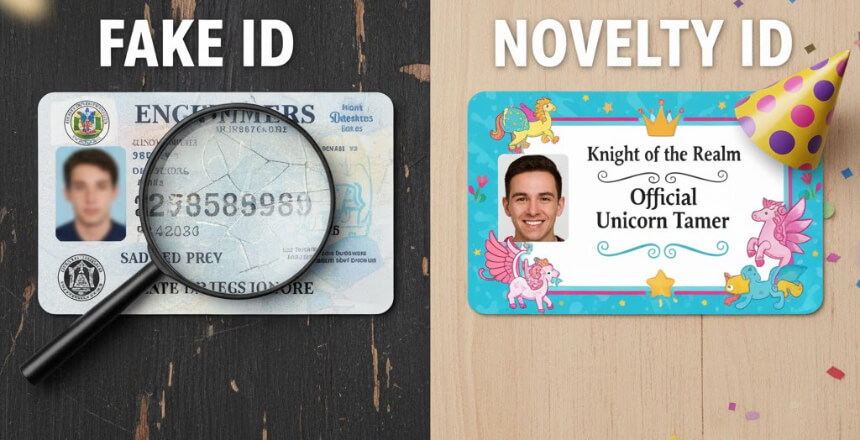
    In simple words, a fake ID is a card intentionally designed to imitate a real U.S. government-issued ID and deceive someone checking it. While, A novelty ID is a fictional or playful card used for fun, props, cosplay, or entertainment, with no intention of replacing a real ID.

    In this guide, I’m going to explain the difference between fake id and novelty id along with criteria used by bars, retailers, and security personnel across the country.

    Let’s dive in…

    Fake ID vs Novelty ID: Quick Summary

    CategoryFake IDNovelty ID
    IntentDeception and illegal useEntertainment, props, or gags
    DesignTries to be an exact replica of official IDsFictional look, uses unofficial design
    LegalityIllegal to own or useTypically legal unless misused
    Security FeaturesAttempts realistic holograms, UV, barcodesLacks official security features
    Use CasePassing age checks, impersonationProps, cosplay, fun
    Risk LevelHigh riskVery low unless misused
    DisclaimerNoneOften includes “Not a government document”

    This table reflects exactly how U.S. law enforcement, retailers, and security teams classify identification cards.

    What Is a Fake ID?

    A fake ID is created to pass itself off as an authentic government-issued document such as a driver’s license, state ID, or passport. In the U.S., this means mimicking highly standardized features set by the AAMVA (American Association of Motor Vehicle Administrators) and individual state DMVs.

    Purpose

    The purpose behind a fake ID is always misrepresentation. People typically attempt to use them in age-restricted locations such as bars, clubs, liquor stores, or casinos. Others may use them to impersonate another person entirely. Regardless of the scenario, the intended outcome is deception.

    This intention is what makes fake IDs legally risky.

    Legality

    Under U.S. federal and state law, possessing or using a fake ID is illegal. States like Texas, California, and New York classify it under “fraudulent identification,” which can lead to:

    • confiscation
    • misdemeanor or felony charges
    • fines
    • probation
    • arrest

    In some states, even attempting to use one without successfully passing it can result in legal consequences.

    This is why bouncers, security guards, and retail staff undergo ID verification training. They’re taught to watch for signs that indicate tampering, misprints, or attempts at deception.

    Appearance and Features

    A fake ID tries to replicate design choices made by real U.S. driver’s licenses. Real IDs include:

    • holographic overlays
    • microprinting
    • UV patterns
    • ghost portraits
    • raised text
    • encoded barcodes that link to AAMVA formatting
    • precise spacing and typeface standards

    Most official U.S. IDs contain multiple layers of embedded security. These layers are intentionally difficult for unauthorized printers to copy.

    When someone creates a fake ID, they try to duplicate these same elements so the card passes a quick glance or blacklight check.

    Production Process

    Fake IDs are made using specialized printers, PVC templates, adhesive laminates, and digital templates that copy real state layouts. They often originate from unauthorized sources trying to mirror government standards closely enough to trick scanners or human inspectors.

    This is different from novelty cards, which are created for entertainment not accuracy.

    What Is a Novelty ID?

    A novelty ID is a fictional or humorous card meant for entertainment. Instead of copying a U.S. government template, it uses fictional designs, bright colors, exaggerated titles, or references to movies, games, or imaginary organizations.

    Think McLovin’s Hawaiian license from “Superbad,” or a “Zombie Apocalypse Response Unit” card someone clips to their backpack for fun. These are novelty items, not identification documents.

    Purpose

    Novelty IDs exist for cosplay, humor, props, costumes, themed parties, creative gifts, or social media videos. The key difference from fake IDs is intent. A novelty ID is not created to deceive; it’s meant to be amusing or fictional from the start.

    A teenager using a Hogwarts ID as a bookmark is not trying to pass it off as a government document.

    Legality

    In most U.S. states, novelty IDs are legal because they do not imitate real government documents and usually contain disclaimers such as:

    “This is not a government-issued ID.”

    The legal issue arises only if someone attempts to use a novelty card as a genuine ID or presents it to law enforcement, airport security, or a business. That action not the card itself is where trouble begins.

    Appearance and Features

    Novelty cards often display their fictional nature through:

    • non-government layouts
    • made-up logos
    • playful titles
    • unrealistic color palettes
    • humor-oriented themes
    • cartoon illustrations
    • fictional organizations

    Unlike fake IDs, novelty IDs intentionally avoid replicating holograms, microprinting, or other anti-fraud measures used by U.S. DMVs.

    Production Process

    Most novelty cards are produced through standard printing services. They focus on creativity rather than security, entertainment rather than deception, and fictional elements rather than accuracy.

    Why People Get Confused

    Confusion usually comes from the shape of the card. Both fake and novelty IDs are printed on PVC plastic using standard card dimensions. So when someone sees a novelty card online like a “Space Federation Commander ID” they assume it’s the same category as a fake ID.

    But once you understand two things intent and authenticity the difference becomes obvious.

    A fake ID tries to be real.

    A novelty ID pretends to be fictional.

    How Inspectors Spot Fake IDs

    People checking IDs in bars and clubs don’t memorize every state’s design. Instead, they rely on cues based on DMV and AAMVA verification standards:

    Texture First

    Real IDs feel layered because of the laminate and raised text. Counterfeit cards often feel smooth, rigid, or too flexible.

    Hologram Behavior

    Real holograms shift cleanly under angled light. Fake holograms often appear dull or blurry because they’re printed instead of embedded.

    Barcode Scanning

    Most U.S. IDs follow AAMVA barcode formatting. Fake barcodes often fail to scan or show mismatched data.

    Microprinting

    Genuine microtext is sharply etched. Most counterfeit attempts print fuzzy microtext that smears on close inspection.

    Data Alignment

    Uneven spacing, inconsistent typography, and misaligned edges are all signs of counterfeit production.

    These checks are standard across the U.S. and taught in ID verification courses for retail workers and nightclubs.

    How to Recognize a Novelty ID (Without Mistakes)

    Novelty cards do not require deep inspection because their fictional elements are obvious when viewed through a real-world context.

    A novelty card may include:

    • a fictional organization
    • humorous titles (“Professional Ninja,” “Space Pilot”)
    • unrealistic layouts
    • creative illustrations
    • intentionally playful themes

    These clues make it clear the card is meant for fun, not fraud.

    Why This Distinction Matters

    In the U.S., many people misunderstand the legal boundaries around ID cards. This creates unnecessary fear around harmless novelty items and downplays the serious risk of using a fake ID.

    Understanding the distinction helps you:

    • know what is safe to purchase
    • avoid legal trouble
    • recognize deceptive documents
    • use novelty items responsibly
    • understand U.S. identification standards

    Clear knowledge protects both consumers and businesses.

    Ready to Order Your Fake ID?

    Order Yours →View Prices

    How Responsible Designers Stay Compliant

    Designing novelty IDs responsibly takes discipline and policy, not just creativity.

    1. Creative Integrity

    We design from scratch colors, typography, emblems without copying any licensed government template.

    2. Legal Review

    Before publishing a design, our compliance team checks:

    • no state or federal seals
    • no identifiable agency names
    • no barcode data structure match

    3. Transparency in Use

    Our checkout, FAQs, and cards carry visible disclaimers.

    We remind users: “Do not use for identification or verification.”

    4. Privacy by Design

    Uploaded photos and signatures are deleted once your card ships.

    We follow FTC and GDPR-equivalent data-retention policies because creative freedom shouldn’t cost privacy.

    Also Read: Is Having a Fake ID Illegal?

    Frequently Asked Questions

    Are novelty IDs legal in the U.S.?

    Yes. Novelty IDs are generally legal as long as they don’t replicate real U.S. government IDs and are not used to deceive. Their fictional themes and disclaimers separate them from fraudulent identification.

    Is owning a fake ID illegal?

    Yes. In the U.S., possessing or using a fake government ID is illegal under state and federal laws. Even attempting to use one at a bar or store may lead to fines or criminal charges.

    Can bars instantly spot fake IDs?

    Not always. But with training, staff learn to check texture, holograms, microprinting, and barcode behavior methods based on AAMVA and state DMV guidelines.

    Why do novelty IDs exist?

    They exist for entertainment: cosplay, movies, themed events, gifts, humor, and collectibles. They’re meant to look fictional, not official.

    Can someone get in trouble for using a novelty ID incorrectly?

    Yes. Even though the card itself is legal, presenting any non-government card as a real ID can result in legal consequences.

    Final Thoughts Creativity with Integrity

    The gap between a fake ID and a novelty ID isn’t just legal; it’s philosophical.

    One exists to deceive. The other exists to create.

    At FakeIDs.com, every design goes through creative review, legal checks, and privacy controls before it reaches you. Because “looking real” shouldn’t mean “acting real.”

    So whether you’re designing a short-film prop, a collector’s display, or a custom gift do it safely, do it ethically, do it creatively.

    Choose artistry. Choose transparency. Choose trust.
  • Best Use Cases for Novelty IDs in 2026

    Best Use Cases for Novelty IDs in 2026

    Novelty IDs are having a quiet comeback.

    Not as something sneaky, but as part of the creator economy: film students, cosplayers, photographers, escape-room designers, even Etsy sellers use ID-style cards as props, collectibles, or fan merch.

    You can see them all over marketplaces as “cosplay IDs”, “prop badges”, or “novelty ID cards” for costumes and themed events.

    If you use them the right way, they’re fun, safe, and completely legal. The key is how you use them.

    Below are the best, high-value use cases for novelty IDs in 2026, with real-world context, examples, and what to pay attention to in each case.

    Order a High-Quality Scannable Novelty ID

    Order Now →

    Film, TV, YouTube and Short-Form Video Props

    If you work with video in any form, novelty IDs are one of the easiest ways to make a scene feel more believable.

    Think about:

    • a character flashing a “press” badge
    • a detective holding a case file ID
    • a student using a campus card at a gate
    • a sci-fi crew member with a ship access pass

    Professional prop teams do this all the time. There’s even behind-the-scenes content on how fake IDs are made for movies and TV, where designers talk about balancing realism with legal safety.
    YouTube

    For your own projects in 2026:

    • Use novelty IDs when your script needs characters with roles: agents, students, staff, crew.
    • Keep everything clearly fictional. No state seals, no DMV layouts, no government branding.
    • Focus on visual clarity: big photo, readable name, role, and maybe department or unit.

    You get all the realism the camera needs, without stepping anywhere near actual ID territory.

    Cosplay, Conventions and Fan Badges

    Cosplay is one of the biggest growth areas for novelty IDs.

    Fans now order:

    • FBI-style badges for supernatural shows
    • agency passes for sci-fi universes
    • Dunder Mifflin staff IDs
    • NASA, K-pop, anime, or game-world badges

    You can see this all over Etsy and fan shops, where creators sell prop badges for TV shows, games, and movies, clearly labeled as cosplay or costume accessories.

    For cosplay, a novelty ID does two things:

    1. Finishes the look. A character ID hanging on a lanyard or clipped to a jacket instantly makes a costume feel “complete”.
    2. Helps people recognise your role. At busy cons, not everyone knows every character. A clear badge can say “PRESS”, “AGENT”, “CREW” or the fandom name.

    To get the most out of it:

    • Match the design to the universe, but keep it clearly fictional.
    • Use your cosplay name or handle, not sensitive personal details.
    • Pick durable materials if you attend crowded events or multi-day cons.

    Collectibles and Fandom Merch

    Some people don’t even wear their novelty IDs. They collect them.

    There are full shops now built around cosplay and novelty ID cards for fans and collectors, printed on PVC or composite stock, often with screen-accurate layouts for specific shows, games, or fictional agencies.

    For collectors, the ID becomes:

    • a small piece of a fandom you can hold
    • something to display in a frame, binder, or shelf
    • a matching set (for example, all main characters from a show)

    If you design for this use case:

    • Think in sets: hero, side characters, different departments.
    • Add small lore references: unit numbers, project names, locations from the fictional world.
    • Make sure the card feels premium in hand (thickness, print quality, finish).

    In 2026, niche collectibles with story and quality often perform better than generic “funny ID” products.

    Photoshoots and Character-Driven Photography

    Photographers are using novelty IDs more often as part of character-based shoots:

    • a street photo series about “city workers”
    • a cyberpunk theme with neon badges
    • a mock security or staff portrait series
    • couples shoots where each person has a playful “role”

    Because the card sits close to the camera, it helps the viewer immediately read the character: “Oh, that’s a medic”, “That’s security”, “That’s crew”.

    For photoshoots:

    • Design with readability in mind. Big text, clear role, good contrast.
    • Make sure the photo you print on the ID matches the shoot’s styling (outfit, makeup, hair).
    • Avoid overloading the card. A few strong fields look better than a cluttered mess.

    If the final photos go online, novelty IDs are also safer than anything that uses your real personal data.

    Gifts, Inside Jokes and Personalized Surprises

    One of the most underrated use cases is simple: gifts.

    People order novelty IDs as:

    • “Employee of the Month” gag cards
    • fake “VIP” passes for birthdays or anniversaries
    • “Official Cat Mom / Dog Dad” badges with pet photos
    • role cards for weddings, stag/hen parties, reunions

    You can even see “custom novelty driver’s license” products marketed openly as party props, gag gifts, cosplay, or themed events.

    For gifts, the magic is in the details:

    • a nickname only friends use
    • a made-up department like “Snack Quality Assurance”
    • a funny “clearance level” or “rank”
    • an expiry date that matches a birthday or event

    Here content matters more than strict design accuracy. The goal is a smile, not realism.

    Escape Rooms, Events and Themed Parties

    Escape-room designers and event planners use novelty IDs as part of the experience:

    • access cards for secret labs
    • undercover agent badges
    • staff passes for fictional corporations
    • visitor passes for alien bases or disaster zones

    Marketplaces are full of downloadable or physical prop badges for mystery parties, spy games and escape rooms, often sold as “CSI”, “secret agent” or “mission” ID props.

    For this use:

    • Think about game flow. Does the card unlock a clue, mark a role, or just decorate?
    • Make each card type visually distinct. Players should tell roles apart quickly.
    • Use colour coding or icons for teams, departments, or difficulty levels.

    A good event ID feels like part of the world building, not just a random plastic rectangle.

    Theatre, Acting Classes and Role-Play Training

    Acting schools, drama groups and role-play trainers use ID-style cards in rehearsal:

    • to help actors stay in character
    • to visualize professions or ranks
    • to support immersive exercises (for example, hospital staff, pilots, crew, reporters)

    Because an ID sits on the chest, it quietly reminds the actor “who” they are in the scene.

    If you design for this context:

    • Keep roles clear and readable from a distance.
    • Use simple, bold layouts that work under stage lighting.
    • Consider lamination or hard plastic if cards are reused every term.

    For corporate or soft-skills training, fictional ID cards can also reduce anxiety. Participants step into a “role” that feels safer than just being themselves.

    Wallet Fillers and Everyday Character Building

    This one is quieter but common: people use novelty IDs simply to personalize their wallet.

    They like opening it and seeing:

    • a sci-fi agency badge
    • an in-universe staff pass from their favorite game
    • a “press” card for a creative side they’re proud of

    It has no function in the real world. It just reminds them of a story or version of themselves they like.

    In 2026, with more people treating identity as a mix of online and offline personas, these tiny objects act like physical extensions of their digital life.

    If you design for this:

    • Focus on aesthetics and durability.
    • Keep the design clean, so it still looks good after months of wear.
    • Avoid dates or text that will feel outdated too quickly.

    A Quick Word on What Novelty IDs Are Not For

    Because search results mix “fake ID” and “novelty ID” content, it is important to be clear.

    Under U.S. federal law, 18 U.S.C. § 1028, the problem is fraud and identity misuse, not film props or fan cards.

    So in 2026, the safe rule stays the same:

    Novelty IDs are fine when used as props, collectibles, costumes, or game pieces.

    They become a problem only when someone tries to pass them off as real identification for age checks, travel, banking, or law enforcement.

    Keeping that boundary clear is good for you, your audience, and your brand.

    Choosing the Right Use Case for You in 2026

    If you are planning novelty IDs this year, ask yourself one simple question:

    “Where will this card actually live?”

    On camera?

    On a lanyard at a convention?

    In a display frame?

    In a game room?

    In someone’s wallet as a private in-joke?

    Once you know that, you can:

    • decide how realistic it needs to look
    • choose what information to include
    • pick materials and finishes that make sense
    • design something that feels thoughtful, not generic

    Used well, novelty IDs are not just plastic cards. They are tiny story devices.

    Ready to Order Your Novelty ID?

    Order Now → View Prices

    Frequently Asked Questions

    1. What can novelty IDs be used for in 2026?

    Novelty IDs are mostly used for filmmaking, cosplay, collectibles, themed photoshoots, escape rooms, gifts and event badges. They’re props not identification.

    2. Are novelty IDs safe to use for cosplay or videos?

    Yes. They’re widely used in conventions, short films, TikTok sketches and theatre. Just don’t use them in real-age or identity checks.

    3. Are novelty IDs legal to own in the U.S.?

    Yes. They’re legal as long as they aren’t used to misrepresent age or identity. They must also avoid real state ID designs.

    4. Can novelty IDs include real personal information?

    They can, but many people use fictional details for privacy, especially for photoshoots and collectibles.

    5. What makes a good novelty ID design?

    A clear photo, readable role/title, fictional details, clean layout, and a finish that matches the theme sci-fi, corporate, fan-universe, or cinematic.

  • Step-by-Step: How to Order a Custom Prop ID on FakeIDs.com (A Real User’s Guide)

    Step-by-Step: How to Order a Custom Prop ID on FakeIDs.com (A Real User’s Guide)

    If you’ve never ordered a custom prop ID before, you’re not alone. It’s one of those things that looks simple from the outside, but once you click around, you start wondering: “Okay… how do I actually do this the right way?”

    That’s what this guide is for.

    I’m not going to throw technical terms at you or talk like a support bot. This is just a normal, human walkthrough of how the process works what details matter, how to take a good photo, what happens behind the scenes, and what you can expect once you hit “submit.”

    Once you understand the flow, ordering becomes super easy, and honestly, a little fun.

    Before You Start: Know What You’re Ordering

    A lot of confusion comes from the word “ID.”

    So let’s clear that up right away:

    FakeIDs.com creates prop, collectible, and novelty IDs. These are for film projects, cosplay, photoshoots, character building, gifts, and display. They’re not government-issued documents and not meant for verification.

    If you’re curious about where the legal lines are, this explains it clearly: Legal Boundaries of Collectible IDs in the US

    Once you understand you’re making something fun and creative — not something serious — you’ll find the whole process much easier to approach.

    Order a High-Quality Premium Novelty ID

    Order Now →

    Your Photo: The Part That Makes or Breaks the Card

    Let’s keep it real: the photo is the biggest factor in how your card will look.

    Designers can fix a few things, but they can’t magically turn a blurry selfie into a crisp, professional-looking prop. Think of your photo as the “face” of the entire project.

    Here’s what works best (practically speaking):

    • Use a real camera when you can (selfies distort your face)
    • Stand against a plain wall
    • Wear something simple and dark so your face stands out
    • Don’t stand too close (6–8 feet works well)
    • Good lighting is everything avoid yellow or colored lights
    • Don’t tilt your head, keep it neutral

    If you want a deeper breakdown with visual examples, here’s the full guide: How to Take the Perfect Photo for Your Custom Prop ID

    Take your time on this part. A good photo makes the final card look sharp and believable.

    Your Signature: Optional, But Adds Personality

    Not every prop ID needs a signature, but when you include one, it gives the card a nice finishing touch.

    Just sign your name on clean white paper using a black marker.
    Snap a clear picture (flash off).

    That’s it.

    No need to overthink it.

    Filling Out the Order Form (And What Each Field Actually Means)

    Now head to Order Page.

    The form looks longer than it really is. Everything is there to help the designer create a clean, well-balanced card, and every field serves a purpose.

    Let me break it down like a real person would:

    Names & Basic Details

    These appear exactly as you type them.

    Misspellings on the form mean misspellings on the card.

    Birthdate, Height, Weight, Eye Color, Hair Color

    These aren’t for verification they’re for character building and prop realism.

    A lot of filmmakers enter their character’s details, not their personal ones.

    Address (Optional)

    If this is for a story or character, feel free to invent an address that fits the scene.

    If you don’t care, the team can generate a fictional one.

    Template Choice

    Choosing a “state” doesn’t mean you’re getting a state ID replica.
    It’s just the design style everything remains novelty-based.

    Photo & Signature Uploads

    These go directly into the design workflow.

    Nothing is shared, nothing is reused, nothing is sent elsewhere.

    If you want to know exactly how your data is protected, read this: How We Keep Customer Data 100% Private

    Optional Custom Numbers (+$20)

    If you’re working on a film set or creating a prop for a storyline, this lets you add specific dates, ID numbers, or continuity details.

    The form is basically you telling the designer how you want your character to “look” on paper.

    Understanding Pricing Before You Pay

    Once you’re done with the form, check the pricing page.

    The breakdown is simple:

    • Standard card price
    • Free duplicate with every order
    • Optional upgrades
    • Bulk discounts
    • Secure payment process

    If you’re ordering for a group (like a cast or a themed event), you’ll save more when ordering multiples.

    How Payment Works (And Why It’s Private)

    Checkout feels like any normal online purchase.

    Payment is processed through secure systems, and none of your full card details are stored on the site.

    Depending on your location, you’ll see different options, including privacy-friendly digital payments.

    If you want a dedicated guide for payment steps, the site links to it during checkout.

    What Happens After You Submit the Order

    This is the part nobody explains, but everyone wonders about.

    Here’s a real behind-the-scenes look:

    1. A human designer opens your photo

    They adjust lighting, crop it, fix minor issues, and prepare it for layout.

    1. Your details are placed carefully

    Spacing, alignment, color balance it’s all done manually.

    1. The card is printed on durable material

    Teslin, PVC, or Polycarbonate the same feel as high-quality prop cards used in productions.

    1. A physical quality check happens

    Misprints, scratches, blur, misalignment everything is inspected.

    1. The card is packed discreetly and shipped

    No flashy labels, nothing revealing.

    Just a normal envelope.

    Most orders ship within 3–5 business days.

    You can find shipping info is here.

    What If Something Goes Wrong?

    Because your card is custom-made, refunds aren’t possible for typos or incorrect details you typed in.

    But the team will replace your order if:

    • the card arrives damaged
    • the print quality is off
    • the details don’t match what you submitted

    I’d suggest you to checkout our refund policy to know more.

    Take a quick photo when reporting issues it speeds things up.

    Your Data: Where It Goes and What Happens After

    This is the part people care about most, and rightfully so.

    Your uploaded photos and details are:

    • used only to make your prop card
    • stored temporarily during production
    • deleted within a short window once your order is complete
    • never reused, sold, shared, or fed into any system

    Everything is handled privately and then removed, no exceptions.

    Our Privacy Policy has everything you want to know.

    Frequently Asked Questions

    1. How long does it take to process a custom prop ID?

    Most orders are designed, printed, checked, and shipped within 3–5 business days. Large group or bulk orders can take a little longer depending on volume.

    2. What type of photo works best for a prop ID?

    A clear, well-lit photo taken with a real camera works best. Stand 6–8 feet from the camera, use a plain wall, avoid colored lighting, and keep your head straight.

    3. Can I use character details instead of my real information?

    Yes. Many customers enter fictional details for cosplay, film projects, and character design. The form only needs accurate spellings to build the card correctly.

    4. How secure is the order process on FakeIDs.com?

    Your uploads and order details are used only to create your prop ID and are deleted shortly after fulfillment. Nothing is stored long term or shared with third parties.

    5. What if I make a mistake on the order form?

    If you spot an error immediately, contact support before production starts. Once printing begins, the team can’t change details, but they will replace misprints or damaged items.

    Ready to Order Your Novelty ID?

    Order Now → View Prices

    Final Thoughts: Once You Know the Steps, It’s Easy

    Ordering a prop ID shouldn’t feel intimidating.

    It should feel creative like building a character or crafting a small piece of a story.

    Once you know:

    • how to take a solid photo
    • what the form fields mean
    • how production works
    • what happens to your data
    • when to expect shipping

    …the rest is smooth and simple.

    If you’re ready to create your own card, Order Your Custom Prop ID now.

  • 9 Smart Tips for Taking a Great Photo for Your Custom Prop ID

    9 Smart Tips for Taking a Great Photo for Your Custom Prop ID

    If there’s one thing that decides whether your ID looks “wow” or “meh”, it’s your photo.

    • Same template.
    • Same printer.
    • Same design.

    One order comes out looking like a clean movie prop.

    Another looks like it was made from a screenshot of a Snapchat story.

    We see that every week.

    So here’s how to take the kind of photo that makes your card look like it belongs on a film set, not in a meme.

    Ready to Order Your Novelty ID?

    Order Now →

    1. Start With a Decent Camera (Your Face Deserves Better Than a Webcam)

    We’ll be honest. We can’t fix a bad source image.

    If the original is tiny, blurry, or taken in the dark, no amount of editing will turn it into something sharp on plastic.

    What usually works well:

    • A digital camera or DSLR
    • A modern phone camera, used properly

    What almost always causes problems:

    • Webcams
    • Old phones
    • Cropped photos stolen from social media
    • Screenshots of screenshots

    If you’re using a phone:

    • Use the back camera, not the selfie one
    • Turn off beauty filters and portrait blur
    • Clean the lens (you’d be surprised…)

    If you zoom in and your face already looks soft, it’s too low-res.

    2. Make the Light Do the Work for You

    Most “bad” photos aren’t about the person they’re about the light.

    • Too dark.
    • Light behind you.
    • Yellow room lighting.

    You want light that hits your face from the front, not from above or behind.

    Easy setups that work:

    • Stand facing a window during the day
    • Don’t have a bright window directly behind you
    • If you’re outside, stand in open shade (not harsh sun)

    Your face should be:

    • Evenly lit on both sides
    • No strong shadows under the eyes or nose
    • No big white glare on your forehead

    If one side of your face disappears into shadow, move, don’t force it.

    3. Use a Boring Background (That’s a Good Thing)

    The best background is the one nobody notices.

    Pick:

    • A plain wall (white, light grey, something neutral)
    • No posters, shelves, tiles, or doorframes

    Stuff that causes headaches:

    • Random furniture
    • Busy patterns
    • Half-open doors
    • Kitchen tiles, curtains, etc.

    You don’t need to tape up a sheet or anything fancy.

    Just find the cleanest, quietest wall you’ve got.

    Step away from the wall a bit around 2–3 feet so you don’t cast a harsh shadow.

    4. Frame It Further Back Than You Think

    Most people stand way too close to the camera.

    For an ID-style photo, we don’t just want your nose and forehead we want some room around you.

    Good rule:

    • Frame mid-chest or waist up
    • Leave space above your head
    • Keep your shoulders in the shot

    Ask someone else to take the photo if you can.

    If you’re doing it alone:

    • Use a tripod/shelf/stack of books
    • Set a timer
    • Step back and relax

    We can crop, straighten and adjust but only if we have enough image to work with.

    5. Stand Straight, Look Straight

    Tiny things make a big difference on an ID.

    If your head is tilted or your shoulders are slanted, it looks weird once we drop it onto a perfectly straight template.

    Try this:

    • Stand naturally, but with shoulders level
    • Look straight at the camera
    • Don’t tilt your head left or right
    • Don’t lean into the lens

    Think “passport photo energy”, just a bit more relaxed.

    6. Wear Something That Works With the Card

    Clothes change the whole feel of your ID.

    You don’t need a suit or anything dramatic just something that doesn’t fight with the background.

    Easy rules:

    • Dark or medium-colored top looks great
    • Avoid tiny patterns and huge logos
    • Skip neon or super reflective fabrics

    If the background is light, a darker shirt usually looks best.

    If the background is darker, medium tones work nicely.

    If you’re going for a character vibe (student, office worker, etc.), keep the outfit simple and clean. The ID design will do the rest.

    7. Make a Clean Signature (It’s Part of the Look)

    A nice photo plus a messy signature image still looks half done.

    Here’s how to give us a signature we can actually use:

    • Take plain white paper
    • Use a black Sharpie or thick black pen
    • Sign once or twice at a natural size
    • Take a photo in good light (no shadows, no yellow tint)
    • Fill the frame mostly with the paper and signature

    We’ll cut it out and place it on the card.

    If it’s tiny, faint, or low-res, it won’t look right when printed.

    8. Do a 10-Second Check Before You Hit Upload

    Before you send your photo, zoom in and ask yourself:

    • Is it sharp, or fuzzy?
    • Can I clearly see my eyes?
    • Is the lighting even, or is half my face dark?
    • Is my head straight?
    • Is there anything distracting behind me?
    • If one of those feels off, it’s worth taking one more shot.

    The difference on the final card is huge.

    9. Don’t Fight the File

    A few quick technical things that help:

    • Send JPG or PNG
    • Don’t over-crop give us extra space, we’ll handle the crop
    • Don’t send a screenshot of a printed photo
    • Avoid sending pictures compressed by random apps or chat platforms

    Think: original file → upload.

    The less it’s edited or squashed before it reaches us, the better it prints.

    Why We’re So Picky About Photos

    We’re not trying to make your life harder we’ve just seen what a good photo can do.

    When the picture is sharp, well-lit, and framed right, the final card feels like something that could sit in a prop drawer on a real set.

    Same template, same printer, same process completely different result.

    Everything else is on us:

    • The template, colors, finishing, printing.
    • Your part is the photo and the signature.

    If you want to see how that all comes together, have a quick look at the Order page. That’s where the form, photo upload, and full process live.

    Before You Hit Submit

    Once you’ve got a photo you’re happy with, do that tiny 10-second check:

    • Is it sharp?
    • Is your face evenly lit?
    • Is the background clean?
    • Is your head straight?

    If you’re unsure what happens after you send everything, the FAQ page walks through what we look at before your card goes into production.

    Good photos help our design team do what they’re good at: matching colors, balancing contrast, and making sure your card looks clean and professional the same attention to detail you see reflected in our pricing and options.

    Ready to Order Your Novelty ID?

    Order Now → View Prices

    Ready When You Are

    If you’ve read this far and you’re ready to get your card made, you’re already ahead of most people.

    You know how to:

    • Set up the light
    • Frame the shot
    • Keep the background simple
    • Get a clean signature

    From here, the next step is easy:

    Head over to the Order page, fill in your details, upload your photo and signature, and choose how you want to pay. If you need a refresher on payment options, the How to Pay page breaks it down clearly.

    Put in a bit of effort on the photo now, and we’ll take care of the rest.

    The goal is simple: when you open that envelope, the card should look like it was always meant to exist.

  • How Novelty IDs Bring Movies and TV Shows to Life

    How Novelty IDs Bring Movies and TV Shows to Life

    How Novelty IDs Bring Movies and TV Shows to Life

    Ever noticed how every cop, agent, student, or nightclub regular on screen always has the perfect ID?

    It pops up for two seconds, but it feels real enough that your brain doesn’t even question it.

    That little card is almost never a real government ID.

    It’s a novelty prop.

    And in film and TV, those tiny details do a lot more work than most people realize.

    Get a Scannable Novelty ID That Looks Real

    Order Now →

    Why Productions Don’t Use “Real” IDs

    On real sets, using actual government-issued ID is a legal headache.

    Studios don’t want:

    • Real names and numbers on screen
    • Legal issues with government agencies
    • Any risk of viewers trying to copy it

    So they lean on custom-made novelty IDs that look believable on camera, but aren’t connected to any real system.

    The film and video industry is huge the global market is expected to reach around $418 billion by 2029.

    Film_And_Video_Market_2025_Graph

    When that much money is on the line, nobody is taking chances with legal stuff.

    Novelty IDs give them realism without the real-world risk.

    Props Are Quiet Storytellers

    In film language, an ID card is a prop any object an actor interacts with.

    Props aren’t just decoration.

    They:

    • Anchor the scene in a specific world (school, hospital, club, agency)
    • Tell you who a character is without a single spoken line
    • Make the environment feel lived-in and believable

    When a character flashes an ID, your brain instantly fills in:

    • “OK, they really go to this college”
    • “They actually work for that agency”
    • “This club is strict, this person got in”

    All of that from one small card.

    There Are A Lot of Props Behind One Scene

    Most people imagine a few key props on set.

    In reality, it’s often hundreds.

    On low-budget sci-fi film Prospect, the production design team said they used “hundreds, literally hundreds of props, both major and minor” across the shoot.

    Go back further to epics like Ben-Hur (1959) and the numbers get wild – the art department produced designs for over a million individual props.

    And it’s not just about volume.

    Props, costumes and set design are all part of the same visual ecosystem that keeps viewers locked into the story. One weak piece breaks the spell.

    How a Novelty ID Is Born on a Film Set

    Here’s roughly how a prop ID goes from script line to actor’s hand.

    1. It starts in the script

    Maybe it’s a line like:

    “She slides her student ID across the counter.”

    Right away, the art department and props team know they’ll need:

    • A school logo
    • A character photo
    • A layout that matches the tone (elite, rough, artsy, etc.)
    1. The designers sketch the world

    Graphic designers create a card that feels authentic but not identical to any real institution or government layout.

    They’ll tweak:

    • Fonts
    • Colors
    • Logos
    • Layout
    • Security elements (hologram-style art, background patterns)

    The goal:

    Looks real enough on screen, but safely fictional.

    1. The prop team prints the physical card

    The design is then printed on plastic with:

    • Lamination
    • Textured finishes
    • Sometimes scannable elements (for realism in close-ups)

    Again, it’s all about on-camera believability, not real-world authentication.

    Why Authentic Props Matter So Much

    When props are lazy or cheap, you feel it.

    Even if you don’t consciously notice.

    Good production designers know the small stuff matters. Some behind-the-scenes breakdowns note that general production costs (including set design and props) are one of the largest chunks of a typical studio film budget.

    And the props industry itself is no small niche.

    The market for film clothing and props rental alone was valued around $1.5 billion in 2023, with projections hitting $2.8 billion by 2032.

    Studios wouldn’t spend that kind of money if props didn’t move the needle.

    Authentic-looking IDs, badges, and passes:

    • Make quick scenes understandable
    • Help actors stay in character
    • Stop viewers from being pulled out of the story

    When you’re watching a thriller and an agent flashes an ID for half a second and you instantly “buy it” that’s the prop department doing its job.

    From Hollywood to Small Productions

    It’s not just big studios using novelty IDs.

    Indie films, web series, student projects, and even YouTube creators rely on prop IDs when they’re:

    • Building a fake university
    • Shooting a nightclub or bar scene
    • Creating fictional companies or agencies
    • Doing mockumentary or parody content

    Many small productions don’t have access to studio prop houses, so they look for specialized novelty ID creators instead.

    The logic is the same:

    • Realistic on camera
    • Safely fictional in real life
    • Designed for entertainment and storytelling

    Fans, Collectors and Cosplayers Love Prop IDs Too

    Once a show becomes popular, fans often want a piece of that world.

    That’s why you’ll see:

    • Replica badges from sci-fi series
    • School IDs inspired by teen dramas
    • Membership cards and club passes from cult movies

    These are sold and traded as collectibles and cosplay props, not real identification.

    The whole appeal is stepping into that fictional universe for a moment:

    • At conventions
    • At themed parties
    • In photoshoots

    Novelty IDs become part of the fan culture around a show or movie.

    The Legal Line: Where Novelty Ends and Trouble Begins

    Here’s the important part.

    On a film set, everyone understands:

    • The ID is a prop
    • It’s part of a controlled environment
    • It has no real-world authority

    The same line exists for collectors and buyers.

    Novelty IDs are for:

    • Props
    • Cosplay
    • Collections
    • Themed events
    • Photography or creative work

    They’re not for:

    • Replacing government IDs
    • Misrepresenting your age or identity
    • Bypassing any legal system or verification

    Responsible creators and sellers are very clear about this.

    That’s why you’ll see disclaimers and usage notes everywhere to make it obvious that these are entertainment products, not documents you can use in real life.

    Where FakeIDs.com Fits Into This World

    Our role is simple.

    We create realistic-looking novelty IDs for:

    • Creators
    • Film and video projects
    • Cosplayers
    • Collectors
    • People who love high-quality props

    We focus on:

    • Design accuracy for on-screen realism
    • Strong materials and print quality
    • Clear language about novelty and prop use only

    No government databases.

    No official authority.

    Just convincing prop pieces for creative and collectible use.

    Ready to Order Your Novelty ID?

    Order Now → View Prices

    Next Time You See an ID on Screen…

    Think about everything hidden behind that one quick shot.

    There’s:

    • A script note
    • A designer
    • A prop maker
    • An actor
    • A whole legal team keeping it safe

    And somewhere in there, a novelty ID doing its quiet job so the story feels real.

    If you’re a creator, photographer, or prop-lover and you’re working on something that needs a realistic card for entertainment or collectible use, you already know how much those details matter.

    That tiny rectangle of plastic might only get half a second on screen.

    But when it’s done right, the audience doesn’t question it for a moment.

    And that’s the whole point.