
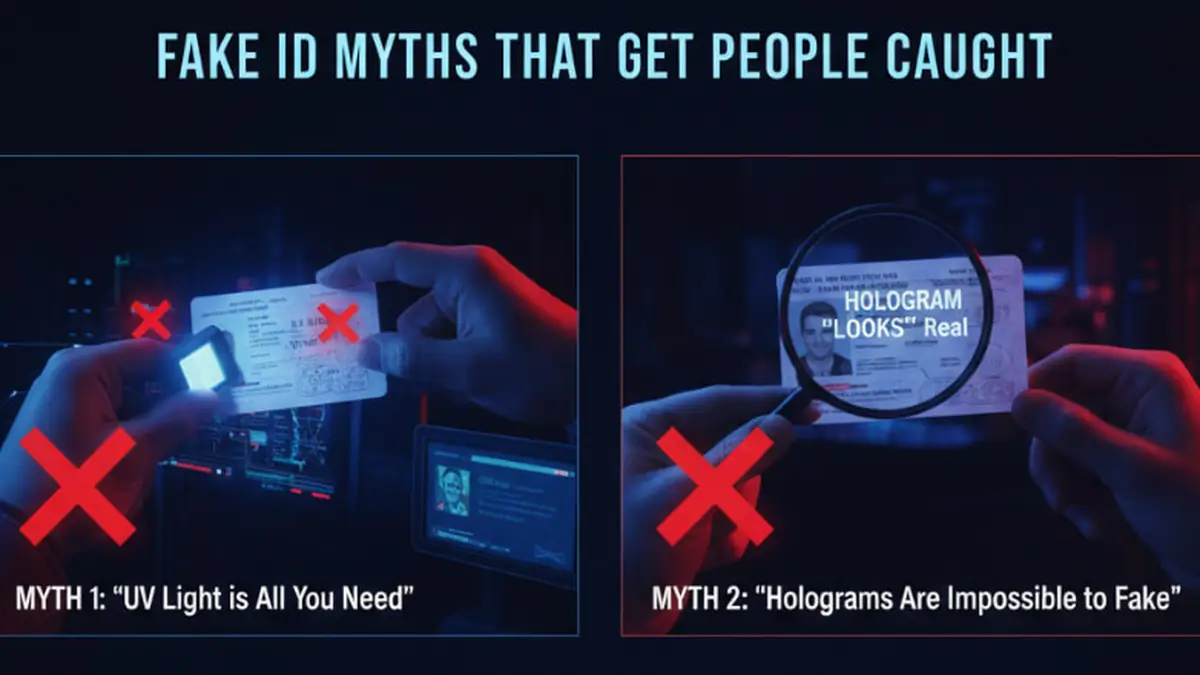
There is a lot of bad advice out there.
If you are thinking about buying a fake ID, you have probably heard the rumors. Your older brother told you one thing. A Reddit forum told you another. You think you know exactly how to beat the bouncer. We cover this in more detail in Fake ID Materials & Quality Guide.
You are probably wrong.
The novelty ID landscape has changed drastically in the last five years. State DMVs have rolled out massive security updates, and bouncers are using better technology than ever before. If you rely on outdated "hacks," you aren't being clever you are walking directly into a trap. The AAMVA data standards determine what scanners check when parsing ID barcodes.
Here are the five biggest fake ID myths that get people caught at the door, the technical reality behind why they fail, and how to avoid making these rookie mistakes. Make It Feel Real in Photos For more on this topic, see our guide on Why Cheap Fake IDs Get You Caught.
A premium novelty card that looks crisp on camera and feels solid in-hand perfect for skits, shoots, cosplay, and gifts. Novelty/prop only. Not valid for identification or access. Myth #1: "If It Scans, You're Good" You can read more about this in How to Take Good Fake ID Photo.
This is the single most dangerous myth in the entire industry.
Ten years ago, a barcode that scanned was a big deal. Today, it means absolutely nothing. Any amateur with a $200 inkjet printer and free software can generate a PDF417 barcode that will "beep" on a basic gas station scanner.
Bouncers know this. The Reality: Tactile and Visual Forensics First
Bouncers use scanners as a backup, not a primary tool. The first test is always physical. Before the bouncer even points the scanner at your ID, they are checking for:
Tactile Feedback: Does the plastic feel like cheap, glued Teslin, or does it feel like heavy, thermally fused Polycarbonate? Raised Text: Can they physically feel the raised, laser-engraved date of birth with their thumb? Optical Variable Ink (OVI): Does the state seal actually shimmer and change color, or is it just printed with shiny gold ink? Learn more about this in our article on Teslin vs Polycarbonate vs PVC Material Science.
If your ID fails the physical "touch test," the bouncer won't even bother scanning it. They will just snap it in half.
Myth #2: "Using a Real 'Borrowed ID' is Safer Than a Fake"
You look somewhat like your older cousin. He gives you his real, expired Driver's License. You think this is the ultimate hack because the ID is 100% authentic. It has real holograms, real weight, and scans perfectly. The Reality: You Are Committing Identity Fraud
Using a "Pass-Down" or Borrowed ID is actually the easiest way to get caught.
Bouncers are trained in Facial Biometrics. They don't just look at the photo; they look at fixed geometrical points on your face that never change, like the distance between your eyes, the shape of your earlobes, and the bridge of your nose. You do not look exactly like your cousin. Our guide on Photo Tips for Custom Prop IDs goes deeper into this.
More importantly, the legal consequences are worse. If you get caught with a novelty ID, it is usually confiscated and you are told to leave. If you are caught impersonating another real human being, you escalate the situation from a minor infraction to Criminal Identity Fraud. Myth #3: "Scratching the ID Makes It Look 'Used' and Legit" The DHS REAL ID program has raised the security baseline for state IDs, making old counterfeiting techniques obsolete.
This is a classic dorm-room myth. People think a brand-new, pristine ID looks suspicious, so they take keys and scratch the hologram, or they rub sandpaper on the edges to make it look "worn in." The Reality: You Are Destroying the Security Features
When you intentionally damage a fake ID, you are doing the bouncer's job for them.
Furthermore, cheap IDs use glued laminate. Scratching the edges causes "delamination" air bubbles form under the plastic, immediately exposing it as a fake. Never damage your ID. Keep it clean and readable. Myth #4: "Just Memorize Your Zodiac Sign and Zip Code"
Movies make it seem like bouncers are constantly giving pop quizzes. They ask you your zodiac sign, your zip code, or your high school mascot to "trip you up." The Reality: The Behavioral "Tell"
While bouncers might occasionally ask a question, they aren't listening to the answer. They are watching your body language.
When people lie, they display micro-behaviors. They avoid eye contact, they shift their weight, or they answer too fast (because they rehearsed it).
If a bouncer asks, "What's your zip code?" and you instantly scream "90210!" with your eyes wide open, you look terrified. Real people have to pause for a second to remember their own zip code. The myth that you need to be a trivia master makes you over-prepared and nervous, which is exactly what gets you caught. Myth #5: "Out-of-State IDs Draw Less Attention"
The logic seems sound: "I live in Florida, but I'll get an Oregon ID. The bouncer won't know what an Oregon ID is supposed to look like, so I'll pass." The Reality: "Out-of-State Scrutiny"
This is the fastest way to get your ID confiscated.
Bouncers know their home state ID perfectly. It takes them one second to verify it. When you hand them a card from a state 3,000 miles away, you break their routine. You force them to stop, look at the reference book, get out the blacklight, and inspect every single security feature on your card.
Unless you have a flawless, state-grade Secure ID, you will not survive that level of scrutiny. The Bottom Line: Engineering Over Myths
Getting through the door has nothing to do with clever hacks or scratched plastic. It comes down to one thing: Material Engineering.
Yes, using a "borrowed" or pass-down ID is highly illegal. While possessing a novelty ID is often treated as a minor infraction, using another real person's government document escalates the crime to Identity Fraud, which carries much heavier legal penalties. Do bouncers really scan IDs?
Yes, but scanning is usually the final step. Bouncers rely on physical inspection first, checking the weight, flexibility, and raised text of the card. A fake ID that scans but fails the physical "bend test" will be confiscated immediately. Should I scratch my fake ID to make it look real?
The most common mistake is poor behavioral security (acting extremely nervous) combined with choosing the wrong state. Using an out-of-state ID from across the country triggers maximum bouncer scrutiny, leading to the ID failing under close inspection.
Frequently Asked Questions
What is the most common fake ID mistake?
The most common mistake is focusing on visual accuracy while ignoring physical properties. A card that looks perfect in a photo but uses the wrong material, wrong thickness, or lacks tactile features will fail the first real-world inspection.
Does confidence really help when using a fake ID?
Confidence affects how you handle the interaction but does not change the card's physical properties. A confident person with a bad ID still gets caught. Confidence only helps if the ID itself is good enough to pass the actual verification checks.
Is it true that fake IDs work better in certain situations?
Yes. Busy venues with long lines and dim lighting offer less scrutiny than quiet bars where staff have time for thorough checks. However, relying on favorable conditions is not a reliable strategy because you cannot control the environment.