
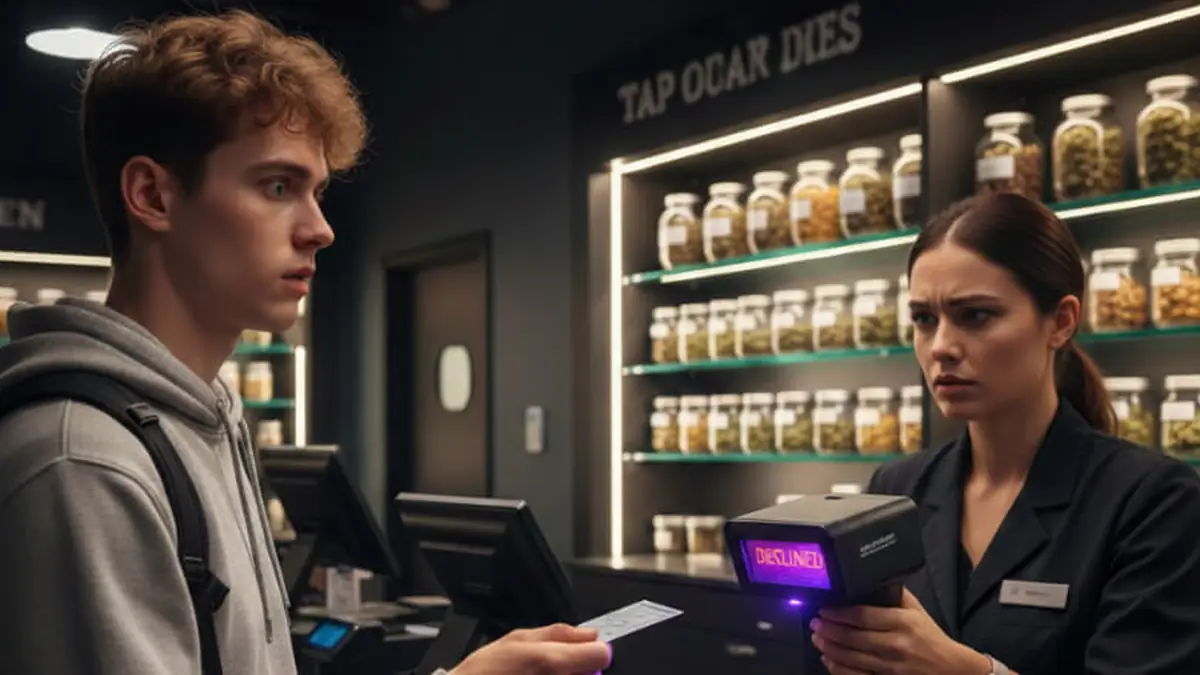
It worked at the dive bar. It failed at the weed shop. Now you're standing on the sidewalk wondering what went wrong.
Here is the truth:
Do dispensaries scan ids with the same tools as bouncers? No. They use enterprise-grade parsers like VeriScan that interrogate your card's data, not just its look. You can read more about this in Fake ID Detection Guide.
In this guide, I'll explain the specific forensic technology dispensaries use and why your "bar-proof" ID is useless against a compliance scanner. Learn more about this in our article on Real Name vs Fake Name Safety Guide.
| Feature | Bar / Club Scanner | Dispensary Scanner |
|---|---|---|
| Scanner Type | Basic age verification app or handheld | Enterprise ID parser (e.g., VeriScan) |
| What It Checks | Date of birth from barcode | Barcode syntax, field logic, ID number algorithm |
| Magstripe Read | Rarely | Yes, cross-checks against barcode data |
| Logic Validation | No (just reads text) | Yes (zip code match, Soundex formula, state format) |
| Staff Training | Minimal, focused on crowd control | Trained on tactile checks, drop tests, UV inspection |
| Penalty for Failure | ~$1,000 fine for the venue | License revocation, criminal charges for operators |
| Environment | Dark, loud, chaotic | Quiet, well-lit, controlled lobby |
Why The Guard at The Weed Shop Cares More Than The Bouncer
Before we talk about scanners and holograms, you need to understand the human being standing in your way. For more on this topic, see our guide on Do Fake IDs Pass Scanners.
Why was the bouncer at the college bar so chill last night? Because he honestly doesn't care.
If a local bar gets caught serving a minor, it is an annoyance. They pay a fine-usually around $1,000. Maybe the bartender gets fired. But the business keeps running. The bouncer is likely underpaid, tired, and relying on a quick visual check because he has a line of 50 people screaming at him. His job is to keep fights from breaking out, not to be a forensic document expert.
As long as the date says you're 21 and the photo looks vaguely like you, he's moving the line.
Now, look at the dispensary.
A cannabis license in a state like California, New York, or Colorado is a "Golden Ticket." It costs hundreds of thousands of dollars to acquire. It involves background checks, zoning hearings, and endless bureaucracy.
If a dispensary gets caught selling to a minor, they don't just get a fine. They lose their license.
The state sends "mystery shoppers" underage agents with fake IDs into dispensaries specifically to test them. Because the stakes are life-or-death for the business, the owners terrify their staff. They don't rely on human judgment. They don't trust the security guard's eyes. They trust the machine.
They invest in enterprise-grade identity verification systems designed to flag anything that isn't 100% perfect. They are looking for a reason to say no.
Do Dispensaries Scan IDs Differently? (The Answer is Yes)
This is the part where 90% of buyers get exposed.
You assume a scanner is a scanner. You think, "If it scans at the club, it scans everywhere."
That is a dangerous assumption. When you ask, "do dispensaries scan ids with the same app as my local club?" the answer is a hard no.
Most bars use simple "Age Verification" apps (like the BCS Scanner app on a phone) or cheap handheld units. These are basically calculators. They scan the barcode to read the date of birth. If the math says "21," the screen turns green. That's it.
Dispensaries use ID Parsers.
Here is exactly what happens inside that machine in the 3 seconds you are standing there sweating. 1. The PDF417 Barcode Analysis
Turn your ID over. See that block of scrambled black lines on the back? That's a PDF417 barcode.
A cheap fake ID generator the kind used by the Instagram scammers will create a barcode that technically scans. It will show your name and birthdate.
But State IDs use a specific data structure called the AAMVA standard. The data inside that barcode is organized in specific "fields" (DAJ, DAK, DAQ).
- DAJ: This code tells the scanner which state issued the card.
- DAK: This code holds the postal code.
- DAQ: This is the ID number itself.
The dispensary scanner parses this data to check the syntax. If the spacing between the fields is off by a single millimeter, or if the header format for "New York" doesn't match the 2024 update, the scanner flags it as a "Format Error."
2. The Logic Check
This is where the cheap fakes die. The scanner runs a logic check on the data hidden in the barcode.
The Zip Code Match: Does the Zip Code hidden in the barcode match the City listed on the front of the card? The Algorithm Check: ID numbers aren't random. They follow a mathematical formula specific to each state. For example, a Florida ID number follows a formula based on your last name and birth date.
If your cheap vendor just slapped a random number on the card, the scanner will calculate the formula, realize the number is mathematically impossible for that state, and reject you. 3. The Magstripe Match
Many modern scanners also read the magnetic stripe (the black strip on the back).
Lazy fake ID makers often leave the magstripe blank or copy-paste data from a different card. When the scanner reads the barcode and then reads the magstripe, it compares the two. If the data doesn't match or if the magstripe is empty it's an immediate fail.
Even if you somehow beat the digital scan, you have to beat the physical inspection.
Dispensary security guards are trained to spot "prop" cards by touch. They handle hundreds of cards a day. They know exactly what a real one feels like.
Real IDs in 2026 are rarely made of PVC (the flimsy plastic used for credit cards). Most modern licenses especially the popular ones like New York, Pennsylvania, and California are made of Polycarbonate. Can You Hear the Difference?
Polycarbonate is a rigid, distinct material. It is built from layers of plastic fused together without glue.
- The Drop Test: If you drop a real ID on a hard table, it makes a distinct "clack" sound almost like a poker chip hitting the felt.
- The Fail: If you drop a cheap fake made of PVC on the table, it makes a dull "thud."
Guards do this all the time. They will tap your card on the counter. If it thuds, you're done. The Tactile Thumb Test
Run your thumb over your ID right now. Is it perfectly smooth? Then it's fake.
Real IDs use Laser Engraving. The text and the photo are burned into the card using high-intensity lasers. This creates a raised texture you can actually feel. The date of birth usually has a tactile "bump" to it.
Cheap vendors use "UV Printers." They print ink on top of the plastic. It might look okay from a distance, but it feels smooth and glossy.
When a guard takes your ID, the first thing they do is run their thumb over the birth date. If it's smooth, they know it's a print-job. They won't even bother scanning it. They'll just hand it back and tell you to leave.
When you want the prop to look intentional clean type, sharp details, and a feel that doesn't scream "cheap." Novelty-only. Not valid for identification or access.
Key Takeaway: Dispensary scanners don't just check your age. They parse barcode field structure, validate ID number algorithms, and cross-check magstripe data. A card that passes at a bar can still fail instantly at a dispensary because the technology is fundamentally different.
Why Using a Fake ID in a Legal State is Actually Harder
Here is something that confuses everyone.
"But weed is legal here! Why are they so strict? Why do they care?"
That is exactly why they are strict.
In states where cannabis is illegal, nobody cares because there are no licenses to lose. But in a "Legal State" like New Jersey, Massachusetts, or California, the government treats cannabis like plutonium. The regulatory bodies are constantly looking for reasons to shut places down to prove they are "tough on crime." The NCSL tracks state cannabis laws including age verification and compliance requirements for dispensaries.
This means the scanners in these states are updated weekly with the latest fake ID signatures.
If you are using an ID from a "Legal State" (e.g., trying to use a California fake in California), you are playing on the hardest difficulty setting possible. The scanners are tuned to detect the tiniest imperfections in their own state's ID. Our guide on Do Police Scanners Detect Fake IDs NCIC goes deeper into this.
So, do dispensaries scan ids from out of state? Yes, but this is where strategy comes in.
If you use a Pennsylvania ID in California, the local scanner might not be as perfectly tuned to the specific micro-updates of the Pennsylvania template. However, it will still run the AAMVA logic checks. Enterprise dispensary scanners can query the AAMVA national database to verify license records in real time.
The mistake people make is buying a fake ID from the same state they are trying to buy weed in.
- Don't use a NY ID in New York.
- Don't use a CA ID in California.
You are handing the guard a document he sees 500 times a day. He knows exactly what the hologram looks like. He knows exactly how the light hits the state seal. He will catch you. The Guard Isn't Stupid: How Your Selfie Gave You Away
Let's talk about the guy standing at the door.
At a club, the bouncer is dealing with drunk people, loud music, and chaos. He is distracted. At a dispensary, the lobby is silent. It's sterile. The guard is sober, bored, and staring directly at you.
You have zero "social engineering" cover here. You can't slip him a $20. You can't flirt your way in.
Because the environment is so controlled, any sign of nervousness is amplified. If you are fidgeting, looking at the floor, or fumbling with your wallet, you are signaling "I am hiding something."
But the biggest giveaway? The Selfie.
I cannot stress this enough. The number one reason IDs get rejected by human guards is that the photo looks like a selfie you took in your bedroom. 1. The Shadow Problem
If there is a shadow behind your ears or under your chin, it means you stood against a wall with a lamp on. Real IDs are taken with "flash boxes" that hit your face with light from all angles to eliminate shadows. A shadow is a dead giveaway. 2. The "Blue Wall" Myth
Stop hanging a blue sheet on your wall. It looks terrible. The vendor has to cut you out of the background using Photoshop. If the lighting is bad, the edges of your hair will look choppy and fake. We always tell our users: Shoot on a white background. Let us add the blue (or grey) digitally. 3. The Camera Angle
Real DMVs have the camera at eye level. If your friend took the photo from slightly above (the classic angle to look skinnier), the perspective is wrong. The guard will spot it subconsciously. It just "looks wrong."
You want to buy weed. You don't want to get banned. You don't want to lose your money.
So, how do you beat the system? Follow this exact checklist.
Stop buying from Instagram. Those guys are reselling garbage or scamming you outright. They don't have the tech to encode magstripes. If they ask for payment in Apple Gift Cards, run. Verify the Scan. Before you ever walk into a dispensary, you need to test your card. Don't just use a free app. If you can, test it on a higher-end scanner or at least use a UV light to check the hidden security layers. Choose the Right Material. If the site you are buying from doesn't explicitly state "Polycarbonate" and "Laser Engraving," close the tab. You are buying a toy, not a tool. Strategy matters. Pick a state that makes sense but isn't local. We cover this in more detail in Bouncer Bend Test Polycarbonate IDs.
When you ask do dispensaries scan ids, you now know the answer is deeper than a simple "yes." They analyze them. They dissect them.
You have two choices. You can save $20 and buy a cheap card that works at a dive bar but gets you humiliated at the dispensary. Or, you can invest in a product that actually replicates the technology required to pass the test.
Don't be the amateur who gets walked out of the lobby. Walk in, scan through, and walk out with what you came for.
Be smart. Be prepared. And get a card that actually works.
Get a Card That Passes the Real Test
AAMVA-compliant barcodes, encoded magstripes, polycarbonate construction, and laser-engraved tactile text. Built to pass enterprise-grade scanners.
Browse StatesFrequently Asked Questions
Do dispensaries scan IDs more carefully than bars?
Yes. Cannabis dispensaries are heavily regulated and face severe penalties for serving underage customers. Their scanning systems are often more advanced than bar scanners and may include database verification that bars typically do not use.
Can a fake ID pass a dispensary scanner?
It is significantly harder to pass a dispensary scanner than a bar scanner. Dispensaries often use compliance-grade verification systems that check barcode formatting, license number validity, and may cross-reference against state databases.
Why are dispensary ID checks stricter than bar checks?
Dispensaries operate under strict state cannabis regulations that require documented age verification for every transaction. A single compliance failure can result in license revocation, heavy fines, or criminal charges for the dispensary operators.