
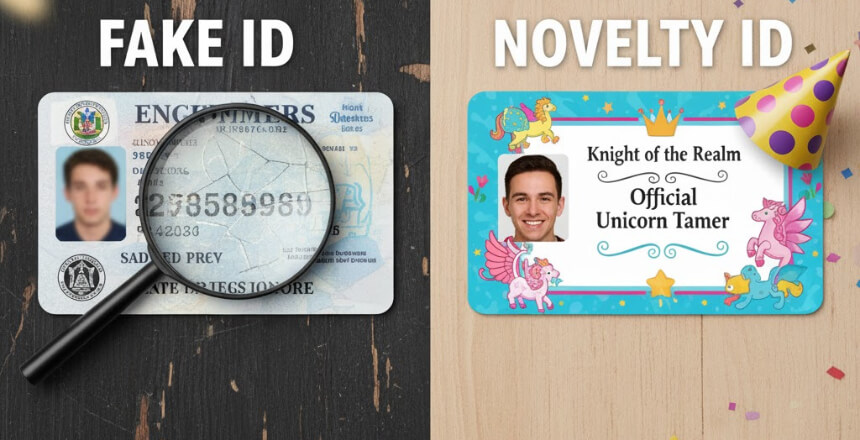
Most people have seen both fake IDs and novelty IDs online, but very few understand how different they really are.
Because, both look like small plastic cards same size, similar thickness, bold text, photos, and sometimes even barcodes.
But in the United States, the distinction between them is not just a design difference; it's a matter of intent, legality, and real-world use.
In simple words, a fake ID is a card intentionally designed to imitate a real U.S. government-issued ID and deceive someone checking it. While, A novelty ID is a fictional or playful card used for fun, props, cosplay, or entertainment, with no intention of replacing a real ID. Our guide on Why Transparency Matters Novelty ID Industry goes deeper into this. The Electronic Frontier Foundation defends creative expression rights, including the production of clearly fictional props.
In this guide, I'm going to explain the difference between fake id and novelty id along with criteria used by bars, retailers, and security personnel across the country. You can read more about this in Novelty ID Education Center.
Let's dive in… Fake ID vs Novelty ID: Quick Summary Category Fake ID Novelty ID Intent Deception and illegal use Entertainment, props, or gags Design Tries to be an exact replica of official IDs Fictional look, uses unofficial design Legality Illegal to own or use Typically legal unless misused Security Features Attempts realistic holograms, UV, barcodes Lacks official security features Use Case Passing age checks, impersonation Props, cosplay, fun Risk Level High risk Very low unless misused Disclaimer None Often includes "Not a government document" For more on this topic, see our guide on Novelty IDs Use Cases. The legal distinction matters because 18 U.S.C. § 1028 targets documents made with intent to deceive.
This table reflects exactly how U.S. law enforcement, retailers, and security teams classify identification cards. What Is a Fake ID?
A fake ID is created to pass itself off as an authentic government-issued document such as a driver's license, state ID, or passport. In the U.S., this means mimicking highly standardized features set by the AAMVA (American Association of Motor Vehicle Administrators) and individual state DMVs. Purpose
The purpose behind a fake ID is always misrepresentation. People typically attempt to use them in age-restricted locations such as bars, clubs, liquor stores, or casinos. Others may use them to impersonate another person entirely. Regardless of the scenario, the intended outcome is deception.
This intention is what makes fake IDs legally risky. Legality
Under U.S. federal and state law, possessing or using a fake ID is illegal. States like Texas, California, and New York classify it under "fraudulent identification," which can lead to:
- confiscation
- misdemeanor or felony charges
- fines
- probation
- arrest
In some states, even attempting to use one without successfully passing it can result in legal consequences.
This is why bouncers, security guards, and retail staff undergo ID verification training. They're taught to watch for signs that indicate tampering, misprints, or attempts at deception. Appearance and Features
A fake ID tries to replicate design choices made by real U.S. driver's licenses. Real IDs include:
holographic overlays microprinting UV patterns ghost portraits raised text encoded barcodes that link to AAMVA formatting precise spacing and typeface standards
Most official U.S. IDs contain multiple layers of embedded security. These layers are intentionally difficult for unauthorized printers to copy.
When someone creates a fake ID, they try to duplicate these same elements so the card passes a quick glance or blacklight check. Production Process
Fake IDs are made using specialized printers, PVC templates, adhesive laminates, and digital templates that copy real state layouts. They often originate from unauthorized sources trying to mirror government standards closely enough to trick scanners or human inspectors.
This is different from novelty cards, which are created for entertainment not accuracy. What Is a Novelty ID?
A novelty ID is a fictional or humorous card meant for entertainment. Instead of copying a U.S. government template, it uses fictional designs, bright colors, exaggerated titles, or references to movies, games, or imaginary organizations. We cover this in more detail in Novelty IDs in Movies and Tv Shows. The FTC consumer protection standards consider intent and labeling when evaluating product legality.
Think McLovin's Hawaiian license from "Superbad," or a "Zombie Apocalypse Response Unit" card someone clips to their backpack for fun. These are novelty items, not identification documents. Purpose
Novelty IDs exist for cosplay, humor, props, costumes, themed parties, creative gifts, or social media videos. The key difference from fake IDs is intent. A novelty ID is not created to deceive; it's meant to be amusing or fictional from the start.
A teenager using a Hogwarts ID as a bookmark is not trying to pass it off as a government document. Legality
In most U.S. states, novelty IDs are legal because they do not imitate real government documents and usually contain disclaimers such as:
"This is not a government-issued ID."
The legal issue arises only if someone attempts to use a novelty card as a genuine ID or presents it to law enforcement, airport security, or a business. That action not the card itself is where trouble begins. Appearance and Features
Novelty cards often display their fictional nature through:
- non-government layouts
- made-up logos
- playful titles
- unrealistic color palettes
- humor-oriented themes
- cartoon illustrations
- fictional organizations
Unlike fake IDs, novelty IDs intentionally avoid replicating holograms, microprinting, or other anti-fraud measures used by U.S. DMVs. Production Process
Most novelty cards are produced through standard printing services. They focus on creativity rather than security, entertainment rather than deception, and fictional elements rather than accuracy. Why People Get Confused
Confusion usually comes from the shape of the card. Both fake and novelty IDs are printed on PVC plastic using standard card dimensions. So when someone sees a novelty card online like a "Space Federation Commander ID" they assume it's the same category as a fake ID.
But once you understand two things intent and authenticity the difference becomes obvious.
A fake ID tries to be real.
A novelty ID pretends to be fictional. How Inspectors Spot Fake IDs
People checking IDs in bars and clubs don't memorize every state's design. Instead, they rely on cues based on DMV and AAMVA verification standards: Texture First
Real IDs feel layered because of the laminate and raised text. Counterfeit cards often feel smooth, rigid, or too flexible. Hologram Behavior
Real holograms shift cleanly under angled light. Fake holograms often appear dull or blurry because they're printed instead of embedded. Barcode Scanning
Most U.S. IDs follow AAMVA barcode formatting. Fake barcodes often fail to scan or show mismatched data. Microprinting
Genuine microtext is sharply etched. Most counterfeit attempts print fuzzy microtext that smears on close inspection. Data Alignment
Uneven spacing, inconsistent typography, and misaligned edges are all signs of counterfeit production.
These checks are standard across the U.S. and taught in ID verification courses for retail workers and nightclubs. How to Recognize a Novelty ID (Without Mistakes)
Novelty cards do not require deep inspection because their fictional elements are obvious when viewed through a real-world context.
A novelty card may include:
- a fictional organization
- humorous titles ("Professional Ninja," "Space Pilot")
- unrealistic layouts
- creative illustrations
- intentionally playful themes
These clues make it clear the card is meant for fun, not fraud.
Why This Distinction Matters
In the U.S., many people misunderstand the legal boundaries around ID cards. This creates unnecessary fear around harmless novelty items and downplays the serious risk of using a fake ID.
Understanding the distinction helps you:
- know what is safe to purchase
- avoid legal trouble
- recognize deceptive documents
- use novelty items responsibly
- understand U.S. identification standards
Clear knowledge protects both consumers and businesses. How Responsible Designers Stay Compliant
Designing novelty IDs responsibly takes discipline and policy, not just creativity. 1. Creative Integrity
We design from scratch colors, typography, emblems without copying any licensed government template. 2. Legal Review
Before publishing a design, our compliance team checks: Learn more about this in our article on How Our Team Designs Prop IDs.
- no state or federal seals
- no identifiable agency names
- no barcode data structure match
3. Transparency in Use
Our checkout, FAQs, and cards carry visible disclaimers.
We remind users: "Do not use for identification or verification." 4. Privacy by Design
Uploaded photos and signatures are deleted once your card ships.
We follow FTC and GDPR-equivalent data-retention policies because creative freedom shouldn't cost privacy.
Frequently Asked Questions
Are novelty IDs legal in the U.S.?
Yes. Novelty IDs are generally legal as long as they don't replicate real U.S. government IDs and are not used to deceive. Their fictional themes and disclaimers separate them from fraudulent identification.
Is owning a fake ID illegal?
Yes. In the U.S., possessing or using a fake government ID is illegal under state and federal laws. Even attempting to use one at a bar or store may lead to fines or criminal charges.
Can bars instantly spot fake IDs?
Not always. But with training, staff learn to check texture, holograms, microprinting, and barcode behavior methods based on AAMVA and state DMV guidelines.
Why do novelty IDs exist?
They exist for entertainment: cosplay, movies, themed events, gifts, humor, and collectibles. They're meant to look fictional, not official.
Can someone get in trouble for using a novelty ID incorrectly?
Yes. Even though the card itself is legal, presenting any non-government card as a real ID can result in legal consequences. Final Thoughts Creativity with Integrity
The gap between a fake ID and a novelty ID isn't just legal; it's philosophical.
One exists to deceive. The other exists to create.
So whether you're designing a short-film prop, a collector's display, or a custom gift do it safely, do it ethically, do it creatively.
Choose artistry. Choose transparency. Choose trust.