
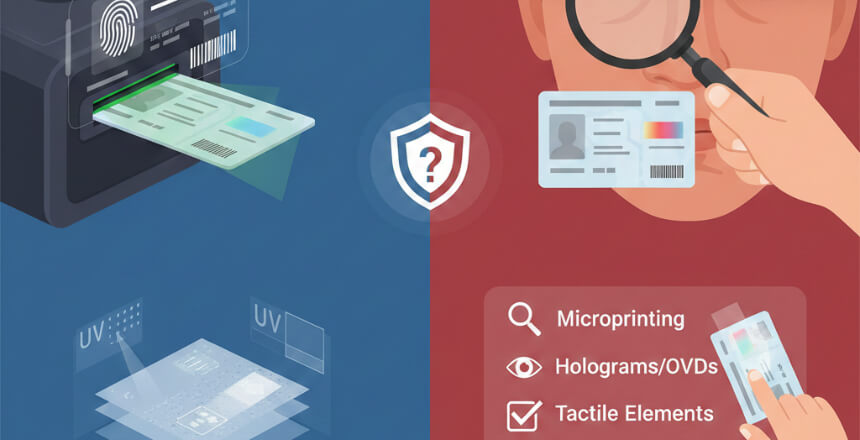
If there's one topic surrounded by more myths than facts, it's fake ID detection.
Some people think scanners are unbeatable machines that instantly expose anything fake. Others think scanners are useless and that only nervous behavior gets people caught. Both views are incomplete. Learn more about this in our article on Do Fake IDs Pass Scanners.
Fake ID detection isn't controlled by a single system. It's a layered process made up of technology, human judgment, training, and enforcement pressure. Once you understand those layers, the confusion disappears. We cover this in more detail in Fake ID Detection and Scanning. The AAMVA data standards form the basis for what ID scanners check during verification.
How are fake IDs usually detected?
Fake IDs are detected through a combination of visual inspection, scanner analysis, and behavioral cues, not through a single fail-safe system. Our guide on Fake ID Detection Guide goes deeper into this.
Most detections happen because:
Something doesn't match expectations Data conflicts appear A trained person notices inconsistencies Enforcement pressure is high at that moment Detection is about probability, not certainty.
Do most places rely on scanners or human checks?
Most places rely on both, but not equally.
Bars, clubs, and liquor stores often start with human inspection. Scanners are used as a secondary tool, not a replacement. In high-risk environments, such as college towns or during compliance operations, scanners become more prominent.
They look for normalcy, not perfection.
Experienced staff check:
How the ID feels in hand Whether the photo matches the face naturally Font spacing and alignment Lamination edges Hologram placement Wear patterns
Real IDs age in predictable ways. Fake ones often don't. You can read more about this in Real Name vs Fake Name Safety Guide.
This kind of inspection is taught in alcohol service training programs like TIPS (Training for Intervention Procedures) and ServSafe Alcohol, both widely used in the U.S.
Why do visual checks still catch so many fake IDs?
Because the human brain is very good at spotting patterns that feel "off."
A scanner can read data, but it can't notice:
Hesitation when handing over the ID Overconfidence Mismatched behavior for the listed age Poor handling of basic questions
Many fake IDs are detected before a scanner is even used.
This is why people are often surprised when they get caught without the ID ever being scanned. What kinds of scanners are used to check IDs?
Most venues use PDF417 barcode scanners, not full authentication systems.
These scanners:
- Read the barcode on the back of an ID
- Display encoded data like name and date of birth
- May flag formatting errors
Common scanner brands include:
These scanners are widely used because they're affordable and easy to deploy.
Do barcode scanners verify IDs against a database?
Most do not.
Basic scanners:
Only check if the barcode is readable Do not connect to DMV databases Do not confirm whether an ID is officially issued
Some advanced systems used by law enforcement or alcohol enforcement agencies do cross-check data, but these are not what most bars or stores use on a daily basis.
Scanner manufacturers openly state this in their documentation. Why do some fake IDs scan while others fail?
Because scanning is about format, not authenticity.
A barcode can:
Be correctly formatted Contain internally consistent data Still represent a completely fake document The National Institute of Standards and Technology contributes research to the detection methods used by advanced verification systems.
Failures happen when:
- Barcode formatting is incorrect
- Encoded data doesn't match printed data
- Scanner software flags inconsistencies
- State formats have changed
As states update ID standards, older formats become easier to detect. How does the Real ID Act affect fake ID detection?
The Real ID Act raised federal standards for state-issued IDs, especially those used for air travel and federal access.
While it doesn't directly criminalize fake IDs, it:
Standardized design elements Increased use of machine-readable features Encouraged better inter-agency data consistency
This indirectly makes fake IDs easier to spot, especially when designs lag behind current standards.
The Department of Homeland Security publishes public documentation on these standards.
Can scanners detect fake IDs on their own?
No, and this is where many misunderstandings start.
Scanners are tools, not decision-makers.
They can:
Read data Flag anomalies Assist staff
They cannot:
Decide legality Replace human judgment Guarantee authenticity
That's why most venues train staff to trust their instincts even when a scanner says "pass." Why do some places confiscate IDs without calling the police?
Because businesses are managing risk, not enforcing criminal law.
Bars and stores:
Confiscate IDs to protect licenses Avoid liability Follow internal policy
In many states, businesses are encouraged or required to confiscate suspected fake IDs under alcohol control regulations.
Police involvement depends on:
State law Venue policy Severity of the situation
How do compliance checks increase detection rates?
Compliance checks are organized operations run by:
State alcohol control boards Law enforcement agencies Licensing authorities
During these operations:
Staff are more alert Scanners are used more frequently Standards are stricter
This is why detection rates spike during certain times of the year, especially in college towns. Can mobile apps really detect fake IDs?
Some mobile apps claim to detect fake IDs, but their effectiveness varies.
Most apps:
Read barcodes Check formatting Provide age calculations
They do not have access to official databases.
Law enforcement-grade tools are not available to the public. Why does behavior matter so much in fake ID detection?
Because behavior provides context that technology cannot.
Staff are trained to notice:
Nervousness or overconfidence Inconsistent answers Avoidance of eye contact Unnatural handling of the ID
These cues often trigger deeper inspection.
Behavioral detection is emphasized in alcohol service training because it's consistently effective. Why do people think scanners are either useless or perfect?
Because people confuse outcomes with systems.
- If a scanner didn't flag an ID once, people assume scanners don't work.
- If a scanner flagged something once, people assume scanners catch everything.
In reality, scanners operate within limits defined by software, configuration, and context. How does law enforcement detect fake IDs differently? For more on this topic, see our guide on Do Police Scanners Detect Fake IDs NCIC.
Law enforcement uses:
Better training More advanced tools Cross-referencing capabilities Legal authority
Traffic stops, investigations, and controlled operations involve far more scrutiny than venue checks.
This is why fake IDs that pass in social settings often fail in official encounters. Why do fake ID detection stories contradict each other online?
Because people describe moments, not systems.
Detection depends on:
Who checked the ID Where it was checked When it was checked Why it was checked
Change any one variable and the outcome can change. What's the biggest mistake people make about fake ID detection?
They assume consistency.
They assume:
- One scanner equals all scanners
- One success equals safety
- One failure equals certainty
Detection systems don't work that way. Final thoughts
Fake ID detection isn't about beating a system. There is no single system to beat.
It's about navigating a space shaped by human judgment, evolving technology, and uneven enforcement. Most people who get caught don't fail because technology exposed them instantly. They fail because assumptions collapsed under real-world conditions.
Understanding how detection actually works removes the myths. It doesn't remove the risk.
And in this topic, removing myths is the most valuable thing education can do.
Frequently Asked Questions
What is the most common way fake IDs are detected?
The most common detection method is tactile inspection by experienced bouncers and bartenders. They check card thickness, material feel, raised text, and flexibility. These physical properties are the hardest for counterfeiters to replicate accurately.
Can trained staff spot a fake ID without scanning it?
Yes. Experienced staff can often identify fakes through visual and tactile inspection alone. They check hologram quality, text alignment, photo positioning, card material, edge finishing, and the overall weight and feel of the card.
What technology is used to detect fake IDs?
Detection technology ranges from basic barcode scanners and UV lights to advanced multi-spectrum scanners that check magnetic stripes, RFID chips, and cross-reference state databases. Higher-end systems can detect fakes that pass simpler checks.