
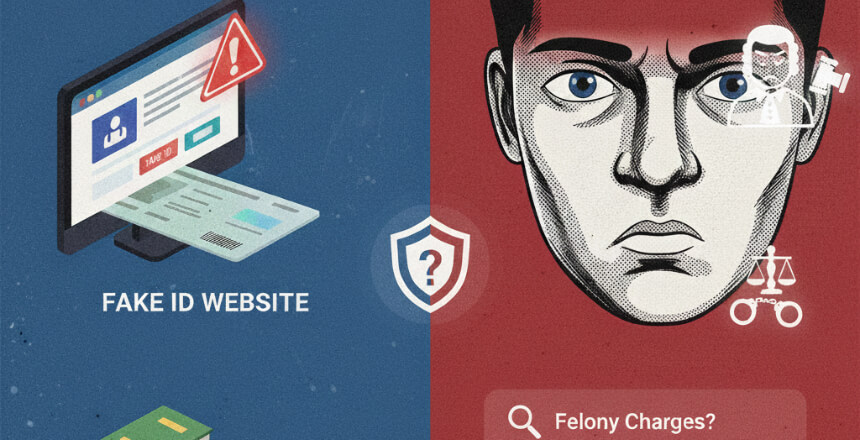
Most of the time, yes if "using" means ordering, paying for, receiving, or trying to use an ID that looks government-issued. That can trigger state laws around false identification, forgery, or identity misrepresentation.
In some cases, federal law can apply when IDs are produced or transferred across state lines, or when mail/carriers are used in a fraud scheme. Browsing a website is different, but the moment you take action, the risk changes. You can read more about this in Fake ID Background Check Medical Law School. The DOJ Criminal Division can assert federal jurisdiction when identity fraud involves interstate commerce or mail.
If you're reading this because you want a straight answer without scare tactics, I've got you. I'll explain what "using" means, where the legal line usually starts, and why outcomes vary so much by state and situation.
What does "using a fake ID website" actually mean?
"Using" can mean browsing, ordering, or presenting the ID and those are three completely different risk levels. Browsing is usually just information. Ordering is a transaction trail (money + delivery + intent). Using the ID is active misrepresentation (age verification, identity checks, access). Laws and enforcement tend to care most about action and intent, not curiosity.
Here's the cleanest way to think about it:
- Browsing: you're consuming content (low legal attention, but not "safe" from scams).
- Ordering: you're attempting to obtain a false identification document (risk jumps).
- Using/presenting: you're trying to make someone accept it as real (highest exposure).
This also explains why online stories conflict.
People say "I used a fake ID site," but they mean different things.
Is it illegal to just visit or browse a fake ID website?
Simply visiting a website isn't prosecuted on its own, but it can still create risk especially if you share personal info or interact with sellers. Most legal trouble starts when you move from reading to attempting: placing an order, uploading photos, paying, or arranging shipping. Browsing isn't a shield from scams, though, and fake ID style sites are common places for data theft and payment fraud.
Here's what people don't realize: even "just browsing" can turn into a problem if you start leaving footprints like:
- sending messages
- uploading selfies
- sharing your address
- paying deposits
- joining Telegram/WhatsApp channels tied to sellers
Even without a legal case, the practical risk is ugly.
If your photo + address + DOB ends up in the wrong hands, the stress lasts longer than the curiosity.
Is it illegal to order a fake ID online?
In many jurisdictions, yes ordering a fake ID online can be illegal because it's an attempt to obtain or transfer a "false identification document." Learn more about this in our article on Is Having Fake ID Illegal.
Even if you tell yourself you'll "never use it," the act of paying, arranging delivery, and receiving it can be treated as intent and possession under state law.
Federal law can also apply in certain circumstances involving production/transfer across state lines.
Ordering is where people accidentally build evidence against themselves.
Not because police are watching every click.
Because ordering creates a trail:
- payment records
- delivery address
- messages and confirmations
- photos you uploaded
- the package itself
And once something is shipped, the story becomes less "online" and more "document + transfer."
Can using a fake ID website become a federal issue?
Sometimes, yes federal law can come into play when false IDs are produced, transferred, or moved in interstate commerce, or when mail/carriers are used as part of a fraud scheme.
The big federal statute people cite is 18 U.S.C. § 1028, which covers fraud related to identification documents, authentication features, and "false identification documents."
Another area that shows up in federal cases is mail fraud (18 U.S.C. § 1341) when mail is used to execute or attempt a scheme to defraud.
Two important clarifications:
- Most cases are still handled under state law.
- Federal exposure increases when there's interstate transfer, organized production, or broader fraud.
Also, quick correction you'll see online: 18 U.S.C. § 1738 (mailing private IDs without a disclaimer) was repealed. So if a blog cites it like it's active, treat that as outdated. Does calling it a "novelty ID" make it legal?
Not automatically labels don't decide legality; function and use do. If the card is designed to be accepted as proof of age or identity, and it closely resembles a government-issued ID, "novelty" won't magically erase the risk. Courts and enforcement tend to focus on whether the document is being presented as real identification, not how it's marketed. Our guide on Novelty IDs Use Cases goes deeper into this.
Here's the real-life test.
A harmless novelty card usually looks obviously fake.
It doesn't mimic a state layout, security features, or barcode patterns.
A risky "novelty" card tries to behave like a driver's license.
That's where people get burned.
Is using someone else's real ID safer than ordering a fake one?
No. Using someone else's real ID can still be illegal because you're claiming an identity that isn't yours. The card may be authentic, but the use is not. Many states treat this as false personation, misrepresentation, or related offenses. We cover this in more detail in Is Using a Fake ID Illegal.
It also tends to trigger faster denial because staff are trained to sin.
People get emotionally fooled by the phrase "real ID."
They think: "If it's real, it can't be that bad."
But the system cares about truth, not plastic quality.
And practically? Borrowed IDs often fail the simplest test:
"Tell me your zip code" or "What's your middle name?"
If a fake ID scans, does that mean it's valid?
No. Scanning usually means the barcode can be read, not that the ID is legitimate or state-issued. Many scanners are "readers," not "verifiers." They display whatever data is encoded, but they don't confirm that a DMV issued the credential or that it matches official records. That's why venues still rely on visual checks and inconsistencies.
This is the easiest way to understand it.
A scanner can read a barcode the way your phone reads a QR code.
Reading is not the same as verifying.
That's why staff often check:
- feel/texture and thickness
- photo alignment and print quality
- DOB format and spacing
- ghost images / microprint (where applicable)
- whether the barcode data matches the front
What usually happens if you get caught after ordering or using one?
The part people don't plan for is the long tail.
Even if there's no dramatic scene, consequences can stack:
- court fees and classes
- missed work/school for appearances
- background check anxiety
- campus discipline (if you're a student)
- DMV-related consequences in some states
Why are fake ID websites risky even beyond the law?
Because many of them behave like scam funnels: they collect sensitive information, take payment, then either disappear or worse, reuse your data. Even if no legal case happens, the identity-risk side can be brutal: photos, addresses, dates of birth, and payment details can be reused for fraud. If your data gets exposed, the right response is treating it like identity theft, not a "bad purchase."
If you only remember one practical point, make it this:
A fake ID website isn't just selling a product.
It's collecting the exact info criminals want.
And once that info is copied, you can't "undo" it.
You can only limit damage.
This is why your content should cover scams: it's user-first and it builds trust. What should you do if you already used a fake ID website?
Don't panic, but do treat it like a security situation especially if you shared photos, address, or payment details. Focus on protecting your identity: monitor accounts, secure your email, and consider freezing your credit if you suspect misuse. If you believe your identity was stolen, use the FTC's IdentityTheft.gov flow to report and get a recovery plan.
Practical steps that actually help:
- Change passwords (email first, then banking/payment accounts)
- Turn on 2FA for email and financial apps
- Watch for new-account alerts and suspicious charges
- Consider a credit freeze if you're at risk (FTC guidance explains this clearly)
- If identity theft occurred, report it via IdentityTheft.gov and follow the steps
Notice what I'm not telling you: how to "avoid getting caught."
That's not helpful. Handling fallout and protecting yourself is. So what's the simple answer: is it illegal or not?
If "using a fake ID website" means ordering or using an ID that claims to be government-issued, it's illegal in many places and can carry serious consequences.
Browsing is usually not prosecuted by itself, but it's still risky because these sites are often scams and data traps. Federal law can apply in certain circumstances related to production/transfer, and mail fraud can apply in broader schemes involving the mail.
Here's the clean summary you can quote:
- Browse: usually not prosecuted alone (but scam risk is real)
- Order: legal risk increases sharply (transaction + intent + delivery)
- Use/present: highest exposure (misrepresentation in the real world)
FAQs: Is Using a Fake ID Website Illegal? Is using a fake ID website illegal?
In many places, yes if "using" means ordering, paying for, receiving, or using an ID that claims to be government-issued. Browsing a website is different, but legal risk usually increases once you attempt to obtain or present false identification. Is it illegal to visit a fake ID website?
Visiting alone is usually not prosecuted by itself, but risk increases if you interact with sellers, submit personal information, or attempt to buy. These sites can also be scam and identity-theft traps.
It can be illegal in many jurisdictions because it involves obtaining or transferring false identification. The exact charge depends on state law and circumstances. Can a fake ID website situation become federal?
Sometimes. 18 U.S.C. § 1028 covers fraud related to identification documents and false identification documents, and mail fraud laws can apply to broader schemes using the mail. Does "novelty ID" make it legal? For more on this topic, see our guide on Fake ID Laws & Legal Consequences.
Not automatically. Labels don't control outcomes; what matters is how closely it resembles a government ID and how it's used. If a fake ID scans, does that mean it's valid?
No. Scanning often means the barcode can be read, not that the ID was issued by a DMV or is legally valid.
Frequently Asked Questions
Is it illegal to use a fake ID website?
Using a website to order a fake ID is not separately illegal from the underlying offense. The legal risk comes from the intent to obtain a fraudulent document, not from the act of visiting or placing an order on a website.
Can you be tracked for using a fake ID website?
If the website does not use encryption and stores customer data, law enforcement could potentially access your information through server seizures or subpoenas. Using secure payment methods and vendors with strong privacy practices reduces this risk.
What charges can I face for ordering from a fake ID website?
Charges may include possession of a forged instrument, criminal impersonation, or identity fraud depending on your state. The severity depends on whether you received and used the product, not just on placing the order.