
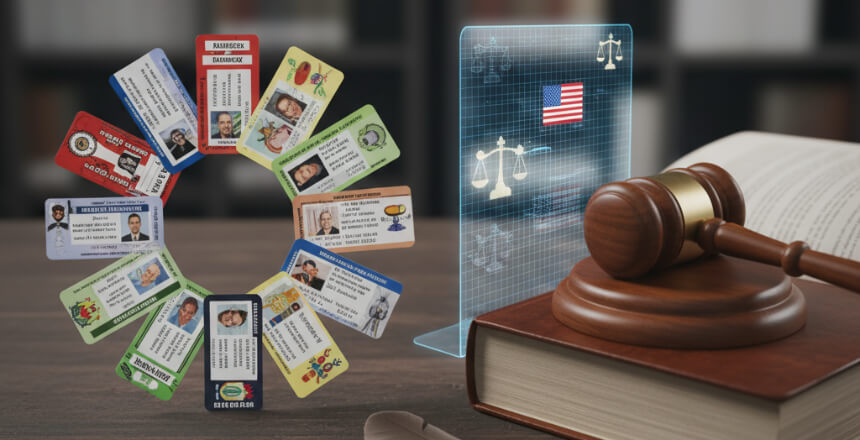
If you're buying a novelty ID, a collectible card, or a film prop, you've probably wondered:
"Is this even legal?"
And honestly, you're not alone.
The internet has mixed fake IDs, prop IDs, collector cards, and counterfeit documents into one giant confusing mess.
Search engines don't always help either they treat everything "fake ID-related" with caution, even when the intent is harmless.
The truth is surprisingly simple:
The legality depends entirely on the intent and the design, not the existence of the card itself.
- Let's make the gray areas clear.
- Two Types of "FAKE ID" (and Why Only One is Illegal)
Most confusion comes from the fact that the phrase "fake ID" has two meanings: 1.Fake ID (illegal meaning)
This refers to a counterfeit identity document created to deceive. Federal law under 18 U.S.C. § 1028 targets documents created with intent to deceive, not clearly labeled collectibles.
Examples:
- A card designed to look exactly like a state license
- Something intended to deceive age checks
- An ID meant to impersonate a government-issued document
This falls under 18 U.S.C. § 1028 which covers "fraud and related activity in connection with identification documents."
It is a federal offense to produce, possess, or use such a document with intent to defraud. 2. Novelty / Collectible ID (legal meaning) We cover this in more detail in Why Fakeids Sells Novelty and Collectible IDs. The Electronic Frontier Foundation provides resources on how creative and artistic works are protected under the First Amendment.
A collectible ID, prop ID, or novelty card is a fictional design created for: Learn more about this in our article on Are Novelty IDs Legal.
Film productions Cosplay Photography props Collectors Personal display Entertainment
These are legal because they're not used to deceive and they don't try to replicate official government layouts.
Fictional, creative, collectible cards with novelty-only purpose. You can read more about this in Why Transparency Matters Novelty ID Industry.
You can read our clarity statement here Disclaimer. What U.S. Law Actually Says
There is no federal law banning novelty or collectible IDs. Our guide on Novelty ID Education Center goes deeper into this.
What the law does prohibit is: 1. Creating or possessing an ID that imitates a real government document
Covered under 18 U.S.C. § 1028.
Illegal if the card:
- uses a real state seal
- copies a real driver's license layout
- includes numbers formatted like DMV IDs
- is intended to deceive an establishment
- can pass machine verification
Manufacturing items that look like federal IDs or badges
Covered under 18 U.S.C. § 701.
This includes:
federal agency IDs law-enforcement badges military credentials
Again, this applies only to documents intended to mislead or impersonate. 3. Using any ID to deceive or misrepresent your identity
Even if the card is "fake," it becomes illegal only when used with criminal intent.
Possession alone without bad intent is not a crime in many states. Intent is everything. What Makes Collectible IDs Legal
Collectible IDs are legal for three simple reasons: 1. They do not replicate real licenses
We intentionally avoid:
state seals DMV-style barcodes official holograms exact color palettes security micro-text government symbols
Our designs are unique, fictional, and artistic.
You can verify this in every product description and on the Order Page. 2. They are never meant for real-world verification
They are used for:
- props
- gifts
- fun
- collections
- creative shoots
That's why every product page and footer clearly states "for novelty / collectible use only."
You can read our Terms & Conditions to learn more. 3. They do not connect to any government or verification system
Real IDs connect to:
DMV databases barcode verification tools law enforcement systems
Collectible IDs do none of that.
Barcodes, if present, are decorative or fictional never functional. Common Misconceptions About Novelty & Collectible IDs
Let's clear up the most widespread misunderstandings many fueled by Hollywood or Reddit threads.
"Any fake ID is illegal."
Wrong.
Only IDs intended to deceive are illegal.
"It's illegal to own a fake ID, even if you never use it."
Not true in most states.
Legality depends on intent.
"Novelty IDs must be reported to the government."
No.
They're treated like props, cosplay items, or memorabilia.
"If it looks high-quality, it must be illegal."
We don't just follow the law we exceed it with strict internal safeguards.
Here's what we do:
Fictional templates only
We don't copy any U.S. state designs.
Even if a card has a "state" name, the layout is 100% custom.
Clear disclaimers everywhere
Our Disclaimer and FAQs clearly define novelty-only use.
No real-security elements
No:
DMV-style barcodes official holograms REAL ID gold stars magstripes with valid data
Everything is decorative.
Data and photo privacy
We delete customer photos within 72 hours following NIST SP 800-88 guidelines.
We covered this deeply in our privacy-focused article: How We Keep Customer Data 100% Private
No replication of official credentials
We stay away from:
federal ID formats military IDs law enforcement lookalikes
Internal compliance checks
Every design passes through:
- a design check
- a compliance review
- a novelty-use validation
- before reaching customers.
Why Collectible IDs Exist (And Who Actually Uses Them)
Collectible IDs aren't just fun there's a real cultural and creative market for them.
Here's where they're used professionally: Film & TV Industry
Production teams need prop IDs for:
- characters
- schools
- security badges
- fictional locations
Photoshoots & Creative Agencies
Artists use them for:
- conceptual visuals
- character-driven work
- in-camera props
Cosplay & Costuming
Fans create:
sci-fi badges character IDs fantasy credentials comic-inspired designs
Gifts & Collectibles
People collect:
novelty cards themed IDs personalized memorabilia
This fits the same category as:
- custom trading cards
- fictional passports
- superhero badges
Not government documents wonderfully fictional items. Good Vs Bad Use (Simple Rules to Stay Safe)
Collectors, photographers, and cosplayers can enjoy novelty IDs safely by following these simple rules:
Don't use them to deceive anyone Don't show them during real ID checks Don't modify them to look like real government IDs Don't claim they are official Don't resell them as "realistic IDs" The FTC sets standards for product labeling that help distinguish novelty items from fraudulent goods.
When used responsibly, collectible IDs are fun, creative, and 100% legal. Final Thoughts
In the U.S., the line between "illegal fake ID" and "legal collectible ID" is defined by:
Intent Design Usage
Our commitment to ethical design, privacy protection, and transparency keeps everything safe and compliant.
Frequently Asked Questions
Are collectible IDs legal to own?
Yes. Collectible IDs are legal to own when they are purchased and kept as novelty items, props, or memorabilia. The legal boundary is crossed when a collectible ID is designed to closely replicate a real government document or is used for fraudulent purposes.
What makes a collectible ID different from a fake ID?
A collectible ID is marketed as a novelty or souvenir and is typically not designed to be an exact replica of a current government-issued document. A fake ID is specifically designed to impersonate a real ID for fraudulent use.
Can I sell collectible IDs legally?
Selling novelty or collectible IDs is legal in most jurisdictions as long as they are clearly marketed as non-government items and not designed to facilitate fraud. Including clear markings like NOT A GOVERNMENT DOCUMENT is a common practice.