
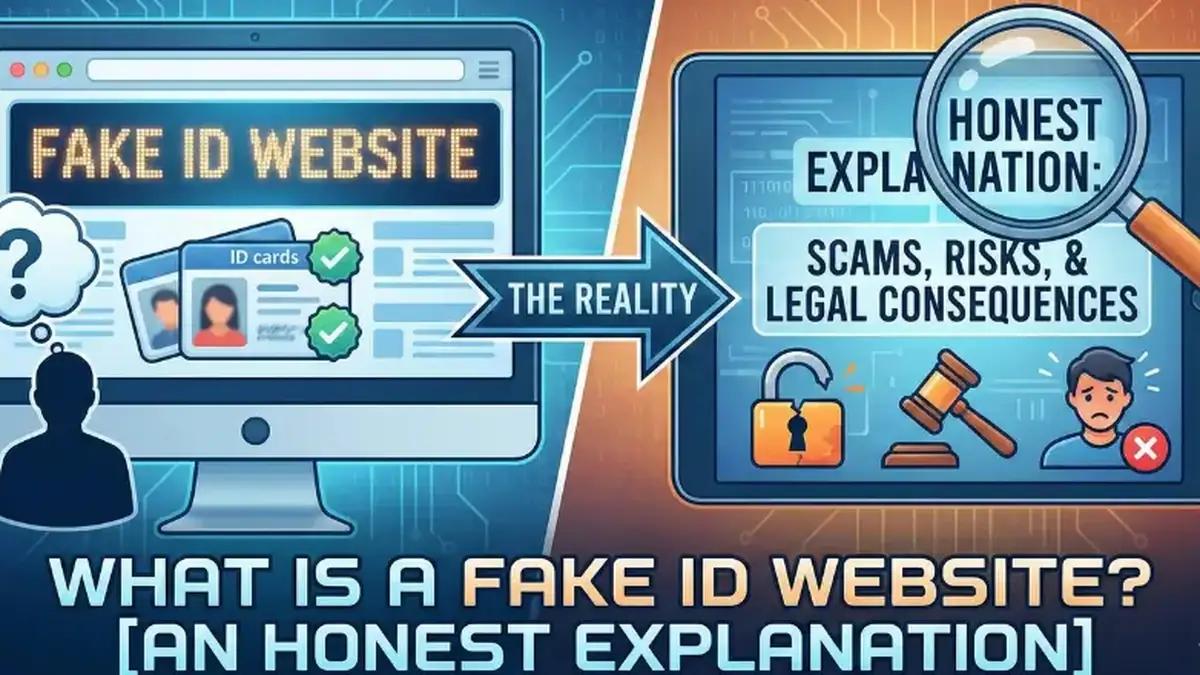
People search for "fake ID website" for a lot of reasons. Some are curious. Some are confused. Some have heard stories from friends and want to understand what's real and what's exaggerated.
And many simply don't trust the information they find online because most pages either scare you unnecessarily or try to push you into a decision without explaining the risks.
This page exists to do neither.
In this post, you'll learn:
- what a fake ID website actually is
- why these websites exist
- how they usually operate at a high level
- what risks people don't think about
- and where most misunderstandings come from...
By the end, you'll have clear understanding about replica IDs, so you won't fall for the fraud.
Let's start with... What Does "Fake ID Website" Actually Mean? For more on this topic, see our guide on Fake ID Website vs Local Fake ID Maker.
A fake ID website is an online platform that claims to sell identification documents designed to resemble government-issued IDs, such as driver's licenses or state ID cards. These websites usually operate independently and are not affiliated with any government agency, DMV, or official authority. We cover this in more detail in Fake ID Website Scams Fakeids. Non-delivery scams can be reported to the FBI Internet Crime Complaint Center.
The key word here is "claims."
Some websites genuinely attempt to produce replicas that look similar to real IDs. Others are novelty-only websites that sell items meant for entertainment or collection. And many are outright scam sites that never deliver anything at all. Learn more about this in our article on Fake ID Website Scam Signs.
This is where confusion starts.
People often use the term "fake ID website" to describe all three categories at once: Our guide on Fake ID Website Safety Guide goes deeper into this.
- Sites that sell fake identification
- Sites that sell novelty IDs with disclaimers
- Scam sites pretending to sell either
Understanding the difference between these is important, especially when people talk about legality, risk, and enforcement. Why Fake ID Websites Exist in the First Place
In the United States, age-restricted access is everywhere. Alcohol purchases, bars, clubs, concerts, certain events, and even some retail products rely on age verification systems. These systems are enforced through state laws and monitored by businesses that risk fines or license suspension if they fail to comply.
For younger adults, especially college students, this creates a familiar pressure point. Social life, campus culture, and nightlife are often built around venues that require valid identification. This doesn't justify anything, but it explains why demand exists.
Fake ID websites are a response to that demand. They operate online because physical, local production carries higher visibility and risk. The internet lowers the barrier to entry, both for sellers and for scammers pretending to be sellers.
This demand-and-response cycle is one of the main reasons misinformation spreads so easily in this space. Who Searches for Fake ID Websites?
There's a stereotype that only one type of person looks up fake ID websites. That stereotype doesn't hold up.
In reality, searches come from several groups:
College students trying to understand what their peers talk about Young adults in strict enforcement states People confused about the difference between novelty IDs and fake IDs First-time searchers who want information, not instructions Parents or educators researching the topic out of concern
Not everyone searching intends to act. Many are simply trying to understand risks, legality, or whether stories they've heard are accurate.
This is why educational content matters more than sensational content. How Does Fake ID Websites Work?
Most fake ID websites present themselves as online vendors. They usually follow a similar structure:
A homepage describing the service Claims about quality or realism An ordering interface Payment options Shipping promises
At a high level, they often claim to operate in three phases: order intake, production, and delivery. The Ordering Concept (Without Instructions)
Fake ID websites usually rely on user-submitted information. This may include names, dates, photos, or other details. How that information is handled varies widely, and this is one of the biggest risk factors people overlook.
Some sites claim to review submissions manually. Others claim automated processing. In reality, users have no way to verify what actually happens behind the scenes. Production Claims
Most fake ID websites emphasize materials and visual features. You'll often see mentions of:
Card thickness Color accuracy Holograms Barcodes or magnetic stripes
These claims are marketing language, not guarantees. There is no independent standard verifying them, and quality varies widely. Delivery and Fulfillment
Shipping is another area where expectations often clash with reality. Some sites claim fast delivery. Others warn about delays. International shipping adds additional risk due to customs, tracking visibility, and interception.
Again, claims are easy to make. Verifying them is not. Fake ID Website vs Novelty ID Website
A novelty ID website usually claims its products are for entertainment, display, or collection. These sites often include disclaimers stating their IDs are not meant for identification or official use. You can read more about this in Novelty IDs Use Cases.
A fake ID website, on the other hand, typically avoids the word "novelty" and markets its products as functional replicas.
The problem is that users often assume novelty IDs are automatically legal or risk-free. That assumption is incorrect. While novelty IDs are positioned differently, misuse can still create legal issues depending on state law and context.
The difference is not just in wording. It's in intent, marketing language, and how products are represented. Are Fake ID Websites Legal or Illegal?
There is no single, simple answer to this question.
In the U.S., fake ID laws are largely handled at the state level. What's illegal in one state may be treated differently in another. Even within a state, the law may distinguish between:
Possession Use Manufacturing Intent to deceive
Some states treat possession as a misdemeanor. Others impose higher penalties if the ID is used to obtain alcohol or access restricted venues. In certain cases, charges escalate if identity fraud is involved.
This is why general statements like "fake IDs are always illegal" or "fake ID websites are legal online" are misleading.
Understanding legality requires looking at:
State statutes Enforcement practices How the ID is used, not just owned
For detailed breakdowns, it's important to review state-specific laws rather than relying on online claims. Are Fake ID Websites Safe to Use?
"Safe" depends on what you mean.
From a legal standpoint, there is always risk. From a financial standpoint, scams are common. From a privacy standpoint, risks are often underestimated.
Fake ID vendors collect personal information. Users often assume this information disappears after production. There's no reliable way to verify that assumption.
Financially, many people lose money to websites that never deliver. Chargebacks are difficult, especially when payment methods are limited or intentionally opaque.
Safety is not just about getting a package. It's about understanding long-term exposure. Can Fake ID Websites Be Traced?
Yes, digital traces exist.
This doesn't mean every order is tracked or investigated, but it does mean the idea of complete anonymity online is a myth.
Potential trace points include:
Payment records Shipping data IP addresses Email communication Platform logs
Even when cryptocurrency is used, transactions still exist on public ledgers. Anonymity depends on behavior, not just tools, and no system is foolproof.
This is one of the most misunderstood aspects of fake ID websites. Do Fake ID Websites Actually Work?
This is the wrong question.
"Work" suggests a consistent outcome, and that's not how reality operates. Outcomes depend on:
Human judgment Venue enforcement standards Staff training Scanner use State-specific verification methods
Some venues rely entirely on visual inspection. Others use scanners. Some do both. Even the same venue may apply checks inconsistently depending on staff, crowd volume, or recent enforcement actions.
This variability is why stories online are so contradictory. One person's experience does not predict another's. What Are Common Myths About Fake ID Websites?
- Let's address some of the most persistent myths.
- Myth 1: All fake IDs scan successfully.
- Reality: Scanning success depends on data accuracy, scanner type, and database cross-checks.
- Myth 2: Paying with crypto means no risk.
- Reality: Payment anonymity does not erase legal or privacy exposure.
- Myth 3: If it ships, it must be legal.
- Reality: Delivery does not determine legality.
- Myth 4: Novelty IDs are always safe.
Reality: Misuse can still result in consequences.
These myths spread because they're comforting, not because they're accurate. Why So Many Fake ID Websites Are Scams
Scams dominate this space for one simple reason: there's very little accountability.
Anyone can create a website, copy images, post fake reviews, and disappear after collecting payments. There's no consumer protection framework enforcing standards.
Common scam patterns include:
Reused photos across multiple sites Reviews that can't be verified No real customer support Vague shipping updates Sites vanishing after a few months
This site are very clear that we sell novelty IDs for fun and entertainment, not to deceive or break the law.
Provide clear definitions Explain laws and risks accurately Break down common misconceptions Help readers understand enforcement and detection Reduce harm caused by misinformation
You won't find checkout pages here. You won't find encouragement or shortcuts.
What you'll find is context. Where to Go Next?
If you're trying to understand this topic fully, the next steps matter.
You may want to explore:
State-by-state fake ID laws How ID scanners actually work Why some IDs fail inspection How scams operate in detail The difference between fake and novelty IDs
Each of these areas deserves focused explanation rather than being compressed into rumors or social media posts. Frequently Asked Questions Can fake ID websites steal your identity?
Yes. Many fake ID websites collect sensitive personal information such as photos, addresses, and payment details, which can be used for identity theft or sold to third parties. What payment methods do fake ID websites usually accept?
Most fake ID websites request non-refundable payments like cryptocurrency, wire transfers, or prepaid cards, making it difficult for victims to recover lost money. Do fake ID websites use fake reviews?
Yes. Many display fabricated testimonials or copied reviews to appear legitimate. These reviews are often reused across multiple domains. Why do fake ID websites frequently change domain names?
They change domains to avoid shutdowns, negative reviews, and law enforcement tracking, allowing the same operators to continue scamming users. Can interacting with a fake ID website cause long-term problems?
Yes. Beyond financial loss, users may face ongoing risks such as identity fraud, spam, blackmail attempts, or legal scrutiny. Are there legal alternatives to using a fake ID?
Yes. Legal alternatives include obtaining proper identification through official government channels or using age-verification services where available. Final Thoughts
Fake ID websites sit at the intersection of curiosity, pressure, misinformation, and risk. Most problems people run into don't come from malicious intent. They come from incomplete understanding.
When people rely on hearsay, shortcuts, or exaggerated claims, they make decisions without seeing the full picture. Education doesn't remove risk, but it reduces surprises.
Before believing claims, stories, or online promises, it's worth understanding how the system actually works, how laws are applied, and why outcomes vary so widely.
Understanding always comes before judgment.
Ready to Order Your Fake ID?
Frequently Asked Questions
What is a fake ID website?
A fake ID website is an online vendor that claims to produce and sell counterfeit or novelty identification documents. These sites operate like e-commerce stores with product listings, order forms, and payment processing for ID card orders.
How do fake ID websites avoid getting shut down?
Many operate from jurisdictions with limited enforcement, use offshore hosting, frequently change domain names, accept only cryptocurrency, and employ various technical measures to maintain anonymity and avoid legal action.
Are all fake ID websites illegal?
Websites selling novelty or prop IDs clearly marketed as non-government items for entertainment purposes may operate legally. Websites that produce documents intended to impersonate real government-issued identification are operating illegally.